
How to Buy a Manufactured Home in Arizona: 2026 Guide
Table of Contents
- Why Manufactured Homes Are Booming in Arizona
- Manufactured vs. Mobile vs. Modular: What the Labels Mean
- Manufactured Home Financing Arizona: FHA, VA, and Dealer Options
- Cost of Manufactured Homes in Arizona: What Drives the Price
- Arizona Office of Manufactured Housing Regulations You Must Follow
- Land, Zoning, and Site Preparation Checklist
- Frequently Asked Questions
Last Updated: October 2, 2026
Why Manufactured Homes Are Booming in Arizona
Manufactured housing has become one of the most practical paths to homeownership for buyers who want to buy manufactured home options instead of site-built construction. This guide from Patriot Homes walks through how to buy manufactured homes in Arizona, from financing and zoning to delivery and title work. Start with financing pre-approval, then match a floor plan to a lot you already control or plan to buy, getting it backwards is the most expensive mistake in this process.
Financing and land come before floor plans. Buyers who pick a home first often discover their lot, zoning, or loan program cannot support it.
Manufactured vs. Mobile vs. Modular: What the Labels Mean
A manufactured home is built to the federal HUD Code in a factory, transported to a site, and installed on a foundation system. That separates it from two terms people use interchangeably but shouldn’t.
- Mobile home: the older term for factory-built homes made before the HUD Code took effect in 1976. Lenders and appraisers treat these differently.
- Modular home: built in sections to state and local building codes, not the HUD Code, then assembled on site. It is legally closer to a site-built house.
- Manufactured home: built after 1976 to the HUD Code, with a permanent chassis and a red certification label.
Single-Wide, Double-Wide, and Triple-Wide: Which Fits Your Land
Single-wide homes are the narrowest and most affordable, delivered as one section. Double-wides arrive as two sections joined on site; triple-wides use three. The wider the home, the more lot width, access road, and transport planning you need.
| Type | Sections | Typical Fit | Watch For |
|---|---|---|---|
| Single-wide | 1 | Narrow lots, tight access | Limited layout options |
| Double-wide | 2 | Most suburban and rural lots | Wider transport route needed |
| Triple-wide | 3 | Large parcels, custom layouts | Highest delivery complexity |
Manufactured Home Financing Arizona: FHA, VA, and Dealer Options
Manufactured home financing Arizona buyers use most often falls into three buckets: government-backed loans, conventional loans, and dealer or in-house arrangements. Which one you qualify for depends on whether the home is classified as real property or personal property.
Real Property vs. Personal Property: The Distinction That Sets Your Rate
A manufactured home is titled one of two ways:
- Personal property (chattel): the home is treated like a vehicle. It has a state-issued title, is not permanently affixed to land you own, and is financed with a chattel loan. Chattel loans typically carry higher rates and shorter terms because the collateral is a depreciating, movable asset.
- Real property: the home is permanently affixed to land you own, the chassis is surrendered or the home is otherwise converted under state procedure, and the home is recorded with the county as part of the real estate. It can then be financed with a traditional mortgage, often at a lower rate and longer term.
The conversion step is not automatic. It requires a foundation meeting the lender’s and state’s standard, a recorded affidavit or title elimination, and coordination between the county recorder, the assessor, and your lender. Buyers who skip it often discover at resale that their home is still titled as personal property.
Ask the lender whether the loan will be secured as real property or personal property before you compare rates. The classification changes your rate, your terms, and how the home is titled.
Government-Backed Loan Programs
- FHA Title I: a smaller loan program for manufactured homes, including homes on leased land in some cases. It is not a standard FHA mortgage and has its own loan limits and terms.
- FHA Title II (standard mortgage): available when the home is classified as real property, meets federal foundation and permanent-affixation requirements, and is on land you own or are buying with the loan.
- VA loan: for eligible veterans, service members, and surviving spouses. VA recognizes both a purchase loan for a manufactured home on owned land and a separate program for homes in a VA-approved lease community. No down payment is required for qualifying buyers, but the home must meet VA foundation and setup standards.
- USDA Section 502: for eligible rural buyers, with income limits that vary by county. Many areas outside the state’s metro corridors qualify.
Conventional and Dealer Financing
Conventional loans from private lenders generally follow Fannie Mae and Freddie Mac manufactured housing guidelines, which distinguish between MH Advantage (homes built to a higher specification, often with permanent foundations and site-built-style features) and standard manufactured homes. MH Advantage loans can come with lower down payments and better pricing.
Down Payment and Credit Requirements
Down payment and credit requirements vary by program and lender. FHA-backed loans generally allow lower down payments than conventional loans, while VA loans can require none for eligible borrowers. Credit score minimums are set by the lender, and manufactured-specific programs often have overlays above baseline agency guidelines.
Cost of Manufactured Homes in Arizona: What Drives the Price
The cost of manufactured homes in Arizona depends on size, finishes, delivery distance, site work, and foundation type, not a single sticker price. Two buyers can order the same floor plan and pay very different totals once transport and installation are included.
The main cost drivers:
- Home size and number of sections
- Finish and customization selections
- Delivery distance and route complexity
- Site preparation, utility hookups, and foundation
- Permits and inspection fees
A quote that covers only the home is not your total cost. Buyers who budget for the house alone often come up short when delivery, foundation, and utility hookups are added.
Arizona Office of Manufactured Housing Regulations You Must Follow
The Arizona Office of Manufactured Housing regulations govern installation standards, licensing, and consumer protections for factory-built homes in the state. The office sits within the Arizona Department of Housing and handles dealer and installer licensing, complaints, and installation requirements.
Before you buy, confirm three things:
- The dealer is properly licensed.
- The installer is licensed for the work.
- The home carries its HUD certification label.
Permits, Title, and Registration
Permits, title, and registration are handled at different levels, and skipping a step creates problems years later. Your county or city issues building and installation permits. The state handles title and registration for personal property homes. If the home is converted to real property, the county recorder and assessor get involved.
The paperwork sequence usually runs like this:
- Apply for local permits before installation begins.
- Complete installation and pass inspection.
- File title or registration documents with the state.
- Record the home as real property if your lender requires it.
Land, Zoning, and Site Preparation Checklist
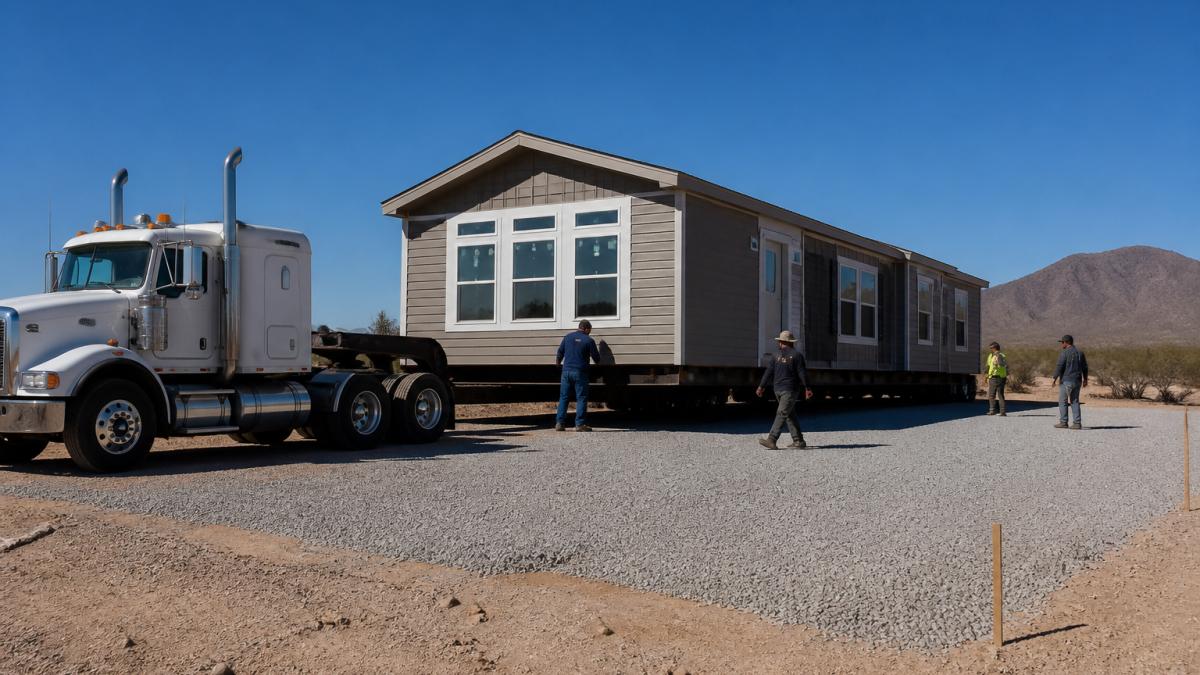
Zoning decides whether you can place a manufactured home on a given lot at all. Many jurisdictions restrict manufactured homes to specific districts, require minimum lot sizes, or mandate a permanent foundation. Check zoning before you buy land, a parcel that looks perfect on a listing site can be zoned for site-built only.
Zoning and Land-Use Checks
Before you make an offer on land, confirm with the county planning department:
- Whether manufactured homes are permitted in that zoning district
- Minimum lot size and setback requirements
- Whether a permanent foundation is required
- Whether the home must meet any age or size minimums (some jurisdictions restrict homes older than a set number of years)
- Whether the parcel is in a floodplain, which triggers additional elevation and insurance requirements
Site Preparation: What Desert Lots Actually Require
This is where most out-of-state guides fall apart: desert site work differs from temperate-climate work, and soil and water conditions drive the cost.
- Soil and pad preparation. Much of the region sits on caliche, a cemented hardpan that is extremely difficult to excavate and does not drain. Some areas have expansive clay soils that swell when wet and shrink when dry, cracking a foundation if the pad is not engineered correctly. A soil report and geotechnical evaluation are not optional on raw land; they determine whether you need over-excavation, engineered fill, or a deeper foundation system.
- Grading and drainage. The pad must be graded so water sheds away from the home. In areas that receive monsoon downpours, poor drainage around the foundation is a leading cause of long-term structural problems.
- Foundation system. Options include a permanent foundation (required for real-property titling and most mortgages), a pier-and-beam setup on a concrete or gravel pad, or a slab. The choice is driven by your lender, your zoning, and your soil report.
- Water. Without a municipal water line, you’ll need a drilled well. Depth and yield vary widely, and a dry hole is a real risk. Get a well feasibility assessment before you buy.
- Sewer or septic. Without a municipal sewer connection, you need a septic system sized to the home’s bedroom count. Approval depends on a percolation test and soil conditions; some desert soils fail perc tests and require a pricier engineered alternative.
- Electric and utilities. Power may need to be extended to the lot, and the distance from the nearest service point affects cost. Propane is common for heating and cooking where natural gas is not available.
- Access for delivery. Wide-load transport requires adequate road width, turn radius, and overhead clearance. A lot that is technically buildable may still be unreachable by a triple-wide carrier.
The Site Preparation Checklist
Work through this with your installer and your county before you commit:
- Confirm zoning allows a manufactured home on the parcel
- Verify lot dimensions and setback requirements
- Confirm road access for wide loads, including turn radius and overhead clearance
- Order a soil report and geotechnical evaluation
- Confirm water source (municipal, well, or hauled) and get a well feasibility assessment if needed
- Confirm sewer or septic feasibility, including perc test if applicable
- Arrange electrical service and any propane or gas connections
- Grade and compact the pad with positive drainage away from the home
- Install the foundation system to the required standard
- Schedule inspections before closing up the underside
Insurance and Resale Value Considerations
Insurance requirements differ based on whether the home is titled as real or personal property. Personal property homes are often insured under a vehicle-like or specialty dwelling policy; real property homes are insured like a house. Ask your insurer which applies before you close.
Two coverage issues come up repeatedly in this climate:
- Wind and hail. Desert windstorms and monsoon hail can damage roofs, siding, and skirting. Confirm the policy’s wind and hail deductibles, which are often separate from the standard deductible.
- Flood. Even properties outside a mapped floodplain can sit in a drainage path during monsoon season. If the parcel is in a FEMA flood zone, flood insurance is typically required by the lender.
Owned land plus real property title is the combination that protects resale value. Rented pads and personal property titles are where depreciation pressure shows up most.
Frequently Asked Questions
What is the average cost of a manufactured home in Arizona?
Cost varies by size, features, and whether you need land. A single-wide typically costs less than a double-wide, and custom finishes add to the total. Site preparation, utility hookups, and delivery are separate line items. Patriot Homes publishes current pricing on its website. Financing terms also affect your monthly payment more than the sticker price alone.
What are the legal requirements for titling a manufactured home in Arizona?
In Arizona, a manufactured home can be titled as personal property or converted to real property if it sits on a permanent foundation and you file the correct affidavit with the county. You will need the manufacturer’s statement of origin, a bill of sale, and proof of installation. The Arizona Office of Manufactured Housing regulates installation standards. Missing a step can delay your title or affect your ability to get a mortgage.
Are there specific FHA loan requirements for manufactured homes in Arizona?
FHA loans for manufactured homes require the home to be built after June 15, 1976, and meet HUD code. It must be on a permanent foundation, titled as real property, and appraised by an FHA-approved appraiser. The lender also reviews the dealer and installation. Down payment can be as low as 3.5% for qualifying buyers. Patriot Homes can connect you with lenders familiar with these rules.
How do I find reputable manufactured home dealers in Arizona?
Look for dealers who are licensed by the Arizona Office of Manufactured Housing, provide transparent pricing, and offer a clear warranty. Ask about their installation process and whether they handle permits and utility hookups. A good dealer will walk you through financing options, site preparation, and titling. Patriot Homes offers 24/7 support and a range of customizable models.