
How to Choose Manufactured Home Finishes: 2026 Guide
Table of Contents
- Start With a Finish-Selection Plan, Not a Showroom Visit
- Manufactured Home Flooring Options: Match Material to Room and Climate
- Manufactured Home Kitchen Finishes: Cabinets, Countertops, and Fixtures
- Manufactured Home Upgrade Costs: What Moves the Price and What Doesn’t
- Durability and Maintenance: Which Manufactured Home Finishes Hold Up
- Health, Efficiency, and Climate: Finishes That Work in Hot, Dry Regions
- Model Home vs. Delivered Home: How to Verify Your Manufactured Home Finishes
- Conclusion
- Frequently Asked Questions
Last Updated: October 18, 2026
Start With a Finish-Selection Plan, Not a Showroom Visit
Most buyers fall for the model home kitchen and sign off on finishes before checking a single price. Choosing manufactured home finishes works better as a plan than a shopping trip, and at Patriot Homes we walk buyers through that plan before anyone picks a cabinet color.
A manufactured home finish is any surface, material, or fixture selected for the interior or exterior of a factory-built home: flooring, cabinets, countertops, paint, siding, and roofing. Finishes decide how the home looks, how it wears, and much of the final price.
Here’s the sequence that keeps you in control.
Step 1: Set Your Finish Budget Before You Look
Decide your finish budget in writing before you tour anything. Split it into three buckets:
- Must-haves: flooring, cabinets, countertops
- Nice-to-haves: upgraded fixtures, accent walls
- Skip-for-now: anything you can swap later
Upgrade costs vary by builder, model, and package, so ask for itemized pricing rather than a lump sum. Our pricing page shows current model pricing to anchor your budget before you visit.
Step 2: Match Finishes to How You Actually Live
A retired couple and a family of five need different floors. Ask yourself:
- Do you have pets or kids?
- How much time will you spend cleaning?
- Will anyone use a walker or wheelchair?
Those answers narrow your finish options fast.
Step 3: Get Every Selection in Writing
Every finish choice should appear on your purchase agreement by name, color, and model number. “Upgraded carpet” means nothing on a contract. “Shaw [style], color [name], model [number]” protects you.
Photograph the model home finishes you like, then ask the dealer to confirm each one is available in your chosen floor plan. Model homes often carry finishes that aren’t standard in every model.
Manufactured Home Flooring Options: Match Material to Room and Climate
The best manufactured home flooring options pair the right material with each room and your local climate. Luxury vinyl plank suits kitchens and baths, carpet suits bedrooms, and tile suits entryways and laundry rooms.
Compare the main choices:
| Flooring | Best Rooms | Durability | Maintenance |
|---|---|---|---|
| Luxury vinyl plank | Kitchen, bath, living | High | Damp mop |
| Sheet vinyl | Bath, laundry | Medium | Easy wipe |
| Carpet | Bedrooms, closets | Medium | Vacuum |
| Ceramic tile | Entry, bath | High | Sweep and mop |
| Laminate | Living, dining | Medium-high | Dry mop |
Floor colors and floor patterns matter too. Light tones make small rooms feel bigger. Dark planks hide scuffs but show dust. In hot, dry regions, vinyl and tile stay cooler underfoot than carpet.
Skipping moisture checks before installing vinyl or laminate in a bathroom can lead to lifted seams and warped planks within the first year. Confirm the underlayment and vapor barrier in writing.
Manufactured Home Kitchen Finishes: Cabinets, Countertops, and Fixtures
Kitchen finishes carry the most visual weight and are where upgrades add up fastest. Start with cabinets, then countertops, then fixtures and appliances.
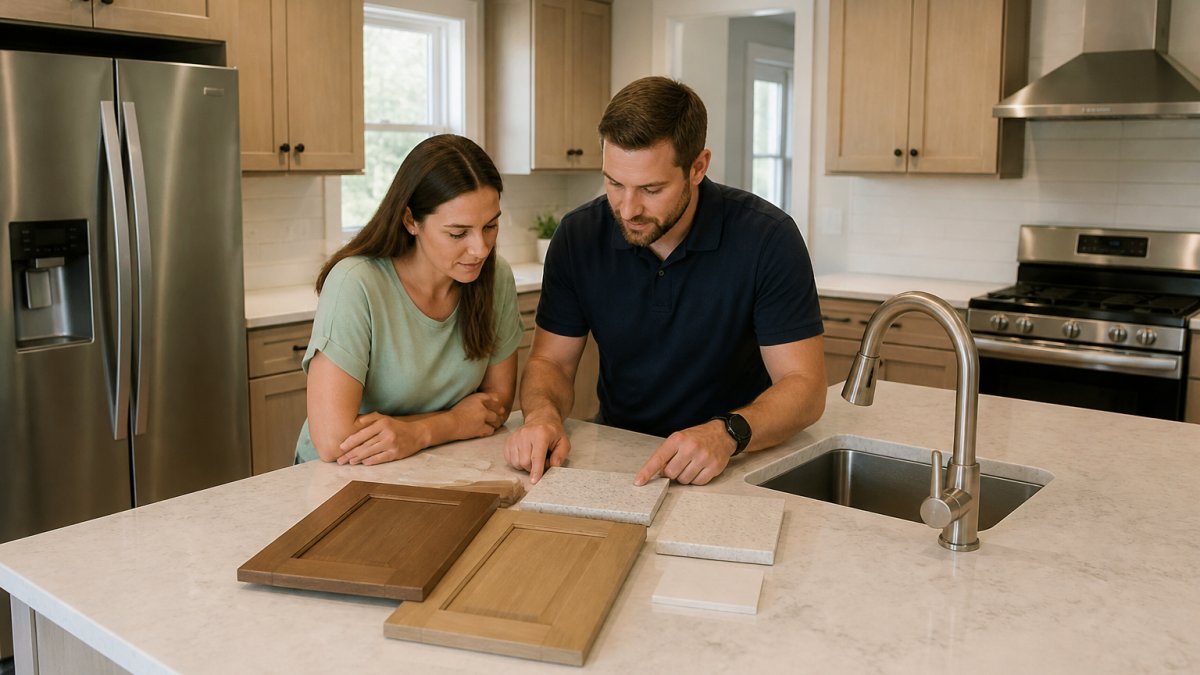
Cabinet choices come down to three things:
- Door style: flat slab, shaker, or raised panel
- Material: laminate-wrapped, thermofoil, or wood
- Hardware: pulls, knobs, soft-close hinges
Countertops range from laminate (budget-friendly) to quartz and solid surface (durable, higher cost). Fixtures include the faucet, sink, and lighting. Stainless steel appliances remain a popular upgrade because they photograph well and resist stains.
Manufactured Home Upgrade Costs: What Moves the Price and What Doesn’t
Manufactured home upgrade costs depend on the package, model, and dealer pricing, so ask for a line-item quote instead of a single total. The goal is to see which line items drive your total and which are bundled into a base price you cannot itemize.
Understand the three pricing layers
Most manufactured home purchases combine three layers:
- Base price: the model as specified in the builder’s standard features list
- Allowances: a dollar credit the builder applies to a category, such as flooring or countertops, which you can spend up or down
- Upgrades and options: line items priced above the allowance or outside the standard package
Ask which layer each finish falls into. A small showroom-card upgrade adds real money across the whole home, and a generous-looking allowance disappears fast if the standard flooring credit is low.
Request an itemized finish schedule
Ask for a written finish schedule that lists, for every selection:
- Category (flooring, cabinets, countertops, fixtures, siding, roofing)
- Brand, style, color, and model number
- Whether it is standard, an allowance item, or an upgrade
A bundled number hides which upgrades drive your total, and you cannot negotiate what you cannot see. Compare builders by matching line items category by category, not bottom lines.
Know which upgrades usually move the price most
Finishes that typically raise the price most:
- Quartz or solid surface countertops
- Upgraded cabinetry with soft-close hardware and full-extension drawers
- Tile flooring in wet areas, which adds labor for substrate and grout
Finishes that usually cost less:
- Paint colors
- Standard carpet in bedrooms
- Basic vinyl in laundry rooms
The pattern is labor and material density: substrate work, specialized installation, or heavier materials cost more than a color swap or standard component.
Watch for substitution and change-order traps
Two cost surprises are common. A model home may display finishes not standard in your floor plan, so confirm availability before you fall in love with a look. And changes after signing often trigger change-order fees and reset production scheduling. Finalize selections before signing, and get any post-signing change quoted in writing.
Ask for a written, itemized finish schedule with allowances and extended prices. A single bundled number hides which upgrades are driving your total, and you cannot negotiate what you cannot see.
Budget for the finishes you cannot see
Some key finish spending is hidden: underlayment and vapor barriers under vinyl or laminate, substrate prep under tile, and ventilation in baths and kitchens. These protect visible finishes and cost less up front than after moisture damage. Ask whether they are in the base price or priced as upgrades.
Durability and Maintenance: Which Manufactured Home Finishes Hold Up
Durability separates finishes that look good on day one from those that still look good in year ten. The winners need the least upkeep and can be repaired without replacing an entire room. Use the comparison below to weigh wear, cleaning, repair, and service life.
Compare finishes by wear, cleaning, and repair
| Finish | Typical wear pattern | Cleaning routine | Repair approach | Expected service life |
|---|---|---|---|---|
| Luxury vinyl plank | Scuffs and dulling in high traffic | Damp mop, avoid standing water | Replace individual planks if locked floating floor | Long-lived in most homes |
| Sheet vinyl | Cuts, tears, and seam lifting | Easy wipe | Patch or replace a section | Moderate |
| Carpet | Matting, stains, pet odor | Vacuum, spot clean, periodic deep clean | Stretch or replace room sections | Shorter in pet or kid households |
| Ceramic tile | Cracked tiles, grout discoloration | Sweep and mop, seal grout periodically | Replace individual tiles | Long-lived with proper substrate |
| Laminate | Swelling at seams if wet | Dry mop, avoid excess water | Difficult to repair; often replace | Moderate |
| Quartz or solid surface counters | Chips at edges, heat marks | Mild soap, avoid abrasive pads | Professional repair for chips | Long-lived |
| Laminate counters | Lifted edges, burns, scratches | Mild soap | Limited repair; often replace | Shorter |
| Thermofoil cabinets | Peeling at edges near heat or moisture | Damp cloth | Spot repair is difficult | Moderate |
| Wood cabinets | Dings, finish wear | Damp cloth, occasional polish | Sand and refinish | Long-lived |
The failure mode matters as much as the lifespan: a finish repairable in place usually costs less over time than one replaced room-wide.
Match durability to the room and the household
High-durability picks:
- Luxury vinyl plank in high-traffic areas
- Ceramic tile in entries and baths, with proper substrate and grout sealing
- Quartz countertops in kitchens
Lower-maintenance picks for retirees and busy families:
- Sheet vinyl instead of tile in laundry rooms
- Laminate instead of hardwood in living areas
- Painted drywall instead of wallpaper
Flat paint hides imperfections but scuffs easily; satin or eggshell wipes clean. For aging in place, choose smooth flooring transitions and lever-style faucets over twist handles.
Ask about moisture and ventilation before you choose
Moisture is the most common cause of premature finish failure. In baths and laundry rooms, confirm underlayment, vapor barrier, and exhaust ventilation in writing. In kitchens, confirm the range hood vents outdoors rather than recirculating. These details protect flooring, cabinets, and countertops more than any single upgrade.
Skipping moisture checks before installing vinyl or laminate in a bathroom can lead to lifted seams and warped planks within the first year. Confirm the underlayment and vapor barrier in writing.
Weigh maintenance time against purchase price
The cheapest finish is not always the lowest-cost finish. A laminate counter replaced in a few years can cost more than quartz that lasts decades, and pet-odor carpet can cost more in cleaning than a hard surface costs to install. Estimate annual cleaning and repair time, compare it against the price difference, and mix durable surfaces in wet, high-traffic rooms with budget finishes in low-wear spaces.
Health, Efficiency, and Climate: Finishes That Work in Hot, Dry Regions
In hot, dry climates, finishes affect comfort and energy bills as much as looks.
What to prioritize:
- Insulation: ask for the R-value in writing
- Roof materials: reflective or light-colored roofing reduces heat gain
- Windows: double-pane, low-E glass
Indoor air quality deserves a question too. The U.S. Environmental Protection Agency’s indoor air quality guidance explains why low-emission materials matter in tightly built homes.
For buyers in hot, dry regions, light exterior colors and reflective roofing are worth the upgrade.
Model Home vs. Delivered Home: How to Verify Your Manufactured Home Finishes
The model home is a sales tool, not a guarantee. Verify every finish before delivery, since displays may include options not standard in your model.
Use this checklist:
- Every finish listed by brand, color, and model number
- Photos of the model finishes attached to your agreement
- Written confirmation of which items are standard vs. upgraded
A home inspection on a new manufactured home is worth the fee. The U.S. Department of Housing and Urban Development’s manufactured housing program sets the federal construction code for manufactured homes, so ask your inspector to confirm compliance.
Signing off on finishes without a pre-delivery walkthrough is the most common buyer mistake we see. Once you accept delivery, correcting a wrong cabinet or floor color becomes your problem, not the builder’s.
Conclusion
Choosing finishes for a manufactured home comes down to three habits: set the budget first, match materials to how you live, and get every selection in writing. Then the showroom becomes a confirmation step instead of a trap.
At Patriot Homes, we build customizable manufactured homes and walk you through finish selection from floor plan to final walkthrough.
Frequently Asked Questions
What finishes can you customize in a manufactured home?
Most builders let you select flooring, paint colors, wall treatments, cabinetry, countertops, plumbing and light fixtures, appliances, and exterior siding and roofing. The exact list depends on the model and the builder’s option catalog. Ask for the written options list for your specific floor plan before you fall in love with a display. Some finishes are standard, others are upgrades with added cost, so confirm which category each selection falls into.
How do you choose durable flooring for a manufactured home?
Match the material to the room. Luxury vinyl plank handles moisture and heavy traffic well in kitchens, bathrooms, and entryways. Carpet suits bedrooms where comfort matters more than spills. Sheet vinyl is the lowest-maintenance option for wet areas. Check the wear layer on vinyl products and ask how the flooring is installed over the subfloor. In hot, dry climates, avoid materials that expand and contract sharply, and confirm the warranty covers the installation method used in your home.
Are upgraded finishes worth the cost in a manufactured home?
It depends on which upgrade. Spend on items that are hard to change later, such as flooring, cabinets, and countertops. Skip upgrades that are easy to swap after move-in, like paint colors or light fixtures. Ask your dealer for an itemized quote showing each upgrade’s added cost so you can compare line by line. Upgrades that improve durability or energy performance usually pay back over time; purely cosmetic ones mainly affect how the home feels to you.
How can you choose finishes that fit your budget?
Set your total finish budget before you visit a showroom, then split it into must-haves and nice-to-haves. Request an itemized list of every selection with its price so nothing hides in a package. Compare the base model against the upgraded display home to see what you are actually paying extra for. Keep a contingency amount for changes, and get the final selection sheet attached to your purchase agreement so the delivered home matches what you approved.