
7 Steps to Verify Utility Access on Vacant Land
Last Updated: October 26, 2026
Quick Summary
To verify utility access on vacant land, pull the parcel number and county records, walk the road frontage for poles and meters, then call each provider to confirm service. Get a written utility availability letter and estimate connection costs before closing.
- Start every check with the assessor’s parcel number, not the street address.
- A power pole near your lot does not guarantee the provider will serve you.
- Call electric, water, sewer, gas, and internet providers separately and log each call.
- Ask the water district whether a main sits at the frontage and capacity exists.
- Make your purchase contract contingent on receiving a written availability letter.
Table of Contents
- How to Check Utilities on a Property Before You Buy
- Start With the Parcel Number and County Records
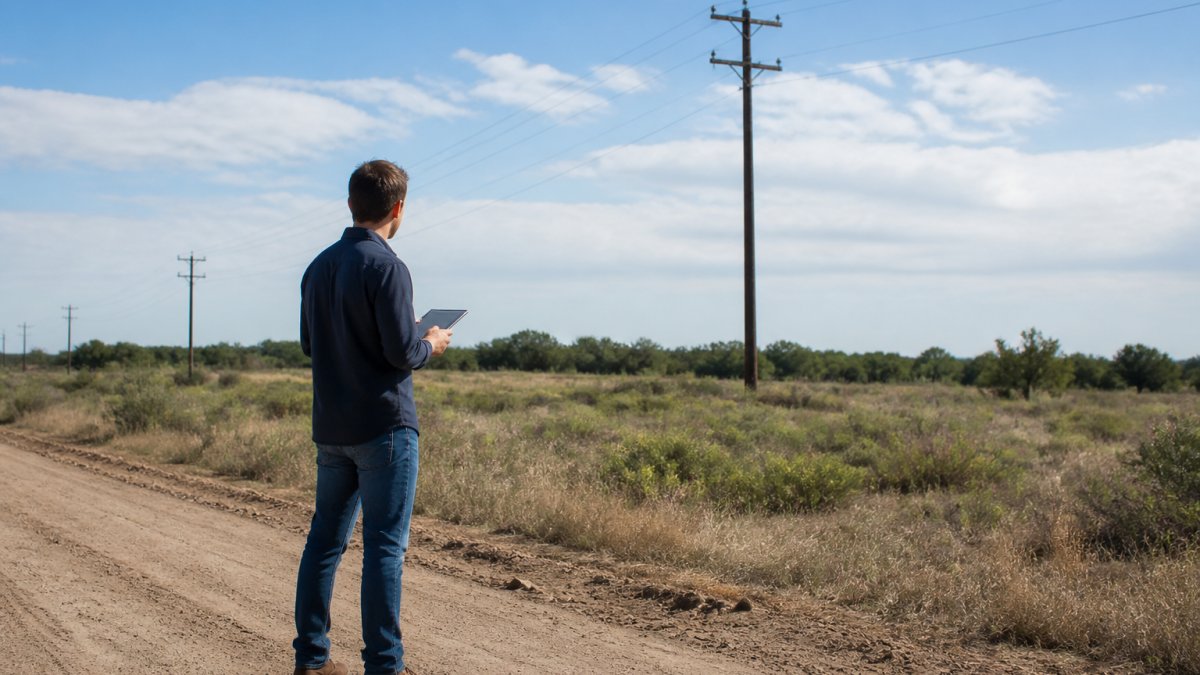
- Walk the Road Frontage and Look for Poles and Meters
- Contact Each Utility Provider to Confirm Availability
- Confirm Water and Sewer Availability for Land
- Understand Any Utility Easement on Vacant Land
- Get a Utility Availability Letter in Writing
- Estimate Connection Costs and Timelines Before Closing
- Call Patriot Homes Before You Commit to a Lot
- Frequently Asked Questions
How to Check Utilities on a Property Before You Buy
Utility access is the single detail that turns a cheap parcel into a buildable one. At Patriot Homes, we walk land buyers through this exact question before they commit to anything, and the answer almost never comes from the listing. It comes from county records, utility providers, and a written confirmation you can hold in your hand.
Here’s the short version: nearby power lines do not mean you can connect. A pole across the road is not a promise. Below, we’ll show you exactly how to verify utility access on vacant land, step by step, so you know what you’re buying before you close.
Start With the Parcel Number and County Records
Every verification starts with the parcel number, not the street address. Rural lots often lack a real address, and the assessor’s parcel number is the only thing that ties your land to a record.
Pull the parcel number from the listing or the county assessor’s site. Then look up:
- Zoning and what it allows
- Recorded easements on the deed
- Prior utility permits or septic approvals
- Flood zone and setbacks
A title company can run a title search that surfaces recorded easements. Ask for it early. What most guides miss is that an easement can exist on paper and never have been built, so the record tells you the right exists, not that a line is there.
Walk the Road Frontage and Look for Poles and Meters
Physical proximity is the easiest thing to check and the easiest thing to misread. Walk the road frontage and note what you actually see.
Look for:
- Power poles and the wires running between them
- A transformer on a nearby pole
- Water meters or meter boxes at neighboring parcels
- Sewer manholes or cleanouts along the road
- Cable or fiber pedestals
Now the hard part. A pole at the edge of your lot means the grid is close. It does not mean the provider will serve you, and it does not mean the cost is small. Distance, terrain, and the provider’s own rules decide that.
Watch out: buyers routinely assume a pole equals a connection and skip the provider call. That single shortcut is how people end up owning land they can’t afford to power.
Contact Each Utility Provider to Confirm Availability
Availability is a provider statement, not a visual one. Call each utility that would serve the parcel and ask the same four questions every time.
- Do you serve this parcel number?
- Is there an existing service connection, or would this be new?
- What is the process and required timeline?
- What will you put in writing?
Do this for electric, water, sewer, gas, and internet separately. They are different companies with different service-area maps, and one saying yes tells you nothing about the others.
Keep a log. Date, rep name, reference number, and what they said. You’ll need it later.
Confirm Water and Sewer Availability for Land
Water and sewer availability for land is where budgets quietly fall apart. Municipal water may end at the neighbor’s meter, and city sewer may stop a half mile short of your parcel.
Ask the water district two things: is there a main at the frontage, and is there capacity to add a connection? Then ask the sewer authority the same. If either answer is no, you’re looking at a well or a septic system.
A well needs a well permit and a yield test. A septic system needs a percolation test and soil that passes. Neither is guaranteed on any given lot.
If sewer isn’t available, our team can discuss practical options. And if you want the full picture on placement, our team can guide you through putting a manufactured home on your own land.
Understand Any Utility Easement on Vacant Land
A utility easement on vacant land is a recorded right that lets a provider, or another party, use part of your property for lines, pipes, or access. It stays with the land, not with the seller.
Read the deed and the title search for:
- Where the easement sits on the parcel
- What it allows the holder to do
- Whether it limits where you can build
An easement across the middle of a lot can rule out the home placement you had in mind. A well-drafted one along the rear boundary usually causes no trouble at all. The difference matters, and it’s on the record before you buy.
Get a Utility Availability Letter in Writing
A utility availability letter is a written statement from a provider confirming whether service can be extended to a specific parcel, and on what terms. It is the document that separates a guess from a fact.
Ask each provider for written confirmation that covers:
- Whether they will serve the parcel
- Any capacity or connection constraints
- The required application and inspection steps
- A cost estimate and expected timeline
Verbal yeses evaporate. A letter survives a closing, a lender review, and a dispute. Get it before your contingency period ends, and make your purchase contract contingent on receiving it.
Estimate Connection Costs and Timelines Before Closing
Connection costs are the number sellers rarely volunteer. They include the hook-up fee, any line extension across your land, trenching, meter installation, and permits.
Costs rise fast when the provider has to extend infrastructure rather than connect to what’s already there. Timelines stretch for the same reason: an extension needs design, permits, and scheduling.
Build a simple worksheet:
| Utility | Who to Call | What to Request | Document to Keep |
|---|---|---|---|
| Electric | Local electric provider | Availability and extension quote | Written estimate |
| Water | Water district | Main at frontage, capacity | Availability letter |
| Sewer | Sewer authority | Connection point and capacity | Availability letter |
| Well | County permit office | Permit steps, testing rules | Permit checklist |
| Septic | County health department | Soil and perc test rules | Test results |
| Internet | Local broadband providers | Service at parcel number | Written confirmation |
Add the totals to your land budget before you sign. A parcel that looks affordable can stop being affordable once the connection numbers land.
Call Patriot Homes Before You Commit to a Lot
Here’s the part that saves people the most money: call us before you buy the land, not after. We help buyers across the counties and cities we serve, from one-bedroom ADUs to spacious four-bedroom models, and we’d rather answer utility questions on a parcel you’re considering than on one you already own.
Why pay more when you can have quality, style, and affordability all in one? Our team is available 24/7 at (888) 765-1776 for pricing matrices, customization options, and immediate help with a lot you’re evaluating. You can also request a quote from our website. If you’re still early in the process, our team can walk you through the full sequence of how to buy a manufactured home.
Frequently Asked Questions
Are utility easements public record?
Yes. Utility easements on vacant land are typically recorded with the county recorder and appear in the property’s chain of title. You can find them through a title search, a plat map, or by requesting the parcel file from the county assessor or recorder. Ask the title company to flag every easement that crosses the lot before closing. A recorded easement tells you where a utility has a legal right to access, but it does not by itself confirm that service is available or that a connection will be approved.
Does a utility easement guarantee that a property can be connected to utilities?
No. An easement only grants a utility the right to cross or occupy part of the property. It does not promise that power, water, or sewer capacity exists, that the provider will approve a new connection, or that the cost will be reasonable. You still need to contact each provider, confirm service availability, and get a utility availability letter in writing. Treat the easement as one piece of the puzzle, not the final answer.
How can you tell if vacant land has access to electricity?
Look for power poles, overhead lines, transformers, and meters on neighboring parcels along the same road. Then call the electric provider that serves that address and ask whether the lot is inside their service area and what a new service connection would require. Physical proximity is a good sign, but only the provider can confirm legal and practical access. Get their answer in writing so you have documentation before you close.
What should you ask a utility company before buying land?
Ask whether the parcel is inside the service area, whether capacity exists for a new connection, what permits and inspections are required, how long the process takes, and who pays for any line extension. Request a written estimate and a utility availability letter. Also ask about road access and right-of-way, since a provider may need legal access to reach the lot. Save every email and reference number in one folder for your records.
Buying land without confirmed utility access is the most expensive mistake we see. Call Patriot Homes at (888) 765-1776 and our 24/7 team will help you review a parcel, talk through floor plans from one-bedroom ADUs to four-bedroom models, and get you a pricing matrix before you commit. Get started with Patriot Homes and buy land with your eyes open.
