
How to Plan Your Site Timeline for a Manufactured Home
Last Updated: November 6, 2026
Quick Summary
Your site development timeline is the schedule for preparing your land, from zoning and clearing through grading, utilities, and permits, and it usually decides when you can move into your manufactured home. The home can be built and installed quickly, but it can only be set once the site is ready, so delays on the land push back your move-in date.
- The factory builds the home on its own clock, while the site clock depends on weather, soil, permits, and utilities.
- Confirm zoning, legal access, and the delivery route before paying for any clearing work.
- Start utility requests and permit applications early, since those often take the longest to schedule.
- Order the home against pad and utility readiness so it does not sit in storage waiting for the land.
- Ask your site contractor for a written estimate listing each phase of the work.
Table of Contents
- Why Your Site Development Timeline Decides Your Move-In Date
- How Long to Prep Land for a Manufactured Home
- Land Suitability, Access, and Site Clearing
- Grading, Drainage, Soil, and Foundation Readiness
- Mobile Home Site Prep: Utilities, Permits, and Inspections
- Manufactured Home Land Development Checklist and Critical Path
- Manufactured Home Delivery and Setup: Coordinating the Final Schedule
- Start Your Project: Call (888) 765-1776 or Request a Quote Online
- Frequently Asked Questions
Why Your Site Development Timeline Decides Your Move-In Date
Your site development timeline is the single biggest factor in when you can actually move into your manufactured home.
Here is the core idea: the home and the land run on two separate clocks. The factory clock is predictable. The site clock is not. Weather, soil, permits, and utility hookups can all stretch the schedule.
- The home is built off-site, often while your land is still being prepared
- Delivery and setup can only happen after the pad, access, and utilities are in place
- Any delay on the site pushes back your move-in date, even if the home is finished
Planning your site timeline early helps you avoid paying for a finished home that sits in storage. To compare how raw land and developed lots affect your project length, read raw land vs developed lots.
How Long to Prep Land for a Manufactured Home
Site preparation duration depends on your land and on weather, so there is no single fixed answer.
Several factors shape how long your prep takes:
- Terrain: Flat, cleared lots move faster than sloped or wooded ones
- Soil: Rocky or unstable ground needs more work
- Weather: Rain and extreme heat can halt crews for days at a time
- Permits: Inspections can add waiting time between phases
Plan for a range, not a single date. Ask your site contractor for a written estimate that lists each phase.
Land Suitability, Access, and Site Clearing
Land suitability is where timelines are quietly lost, because problems found here force redesigns that ripple through every later phase. Before you order a home, confirm four things: zoning that allows a manufactured home, a lot size and setback that fit your chosen floor plan, legal road access to the parcel, and a delivery route a large transport can physically use.
Zoning and legal access
Zoning is not a formality. Local rules can restrict manufactured homes to certain districts, require minimum lot sizes, or set setback distances from property lines. If the parcel lacks recorded legal access, a deeded easement or frontage on a public road, you may need an easement recorded before any permit is issued. That is a legal process, not a construction task, and it can run on its own calendar.
- Confirm the zoning district allows the home type and size you want
- Verify legal access is recorded, not just physically present
- Check setbacks, height limits, and any HOA or CC&R restrictions
Watch out: A lot that looks buildable on a map can fail a zoning check because of an unrecorded easement or a setback encroachment, resolve this before you pay for clearing.
Delivery route and access
A manufactured home arrives on a transport that is far longer and heavier than a standard truck. The route from the nearest highway to your pad must handle that load: road width, bridge weight limits, overhead lines, tight turns, and tree canopy all matter. On rural parcels, the final approach, a driveway, a culvert, a gate, often needs widening or reinforcement before delivery day.
- Drive the route yourself and note narrow bridges, low branches, and sharp turns
- Confirm the driveway can support the transport and the set crew’s equipment
- Clear overhead obstructions along the final approach
Clearing and debris removal
Clearing removes trees, brush, stumps, and any old structures before grading can begin. On wooded lots this is the phase most often underestimated. Stump removal and debris hauling can add time depending on the size of the job.
- Mark trees to keep before crews arrive so you don’t lose landscaping you wanted
- Confirm whether stump grinding or full removal is included
- Ask where debris goes and who pays for hauling
How these phases sequence
Suitability checks come first because they can cancel or reshape the project. Clearing follows, then grading. If you clear before confirming zoning, you may spend money on a lot that cannot legally host the home. If you grade before clearing, roots and debris undermine the pad. The order is not optional, each phase depends on the one before it.
If you are unsure whether a parcel in your area will pass these checks, call our 24/7 team at (888) 765-1776 and we will walk you through what to verify first. We proudly serve local homeowners with custom manufactured and modular options, from 1-bedroom ADUs to spacious 4-bedroom models.
Grading, Drainage, Soil, and Foundation Readiness
Grading shapes the ground so water flows away from the home. Drainage problems that go unchecked can cause long-term issues, so this phase should not be rushed. Soil conditions matter just as much. Soil compaction must be tested so the foundation has a stable base.
Your foundation system depends on the soil and the home’s design. Your contractor will confirm the right support system for your site. Once grading and compaction pass, the pad is ready for setup. Skipping a soil check can add weeks of rework later, so ask whether testing is included in your quote.
Mobile Home Site Prep: Utilities, Permits, and Inspections
Utilities are often the hidden delay. Water, sewer or septic, and electrical service each need their own connection plan. Some utilities take longer to schedule than the rest, so start those requests early.
Permits and inspections come next. Your local building department will set the rules and inspection points. Each inspection must pass before the next phase starts. Keep a running list of which permits are filed, approved, and still pending.
Here is a simple way to track utility and permit status:
- Utility requests: Submit as early as possible
- Permit applications: File before the site work begins
- Inspections: Book them as each phase finishes
- Final approval: Needed before move-in
Manufactured Home Land Development Checklist and Critical Path
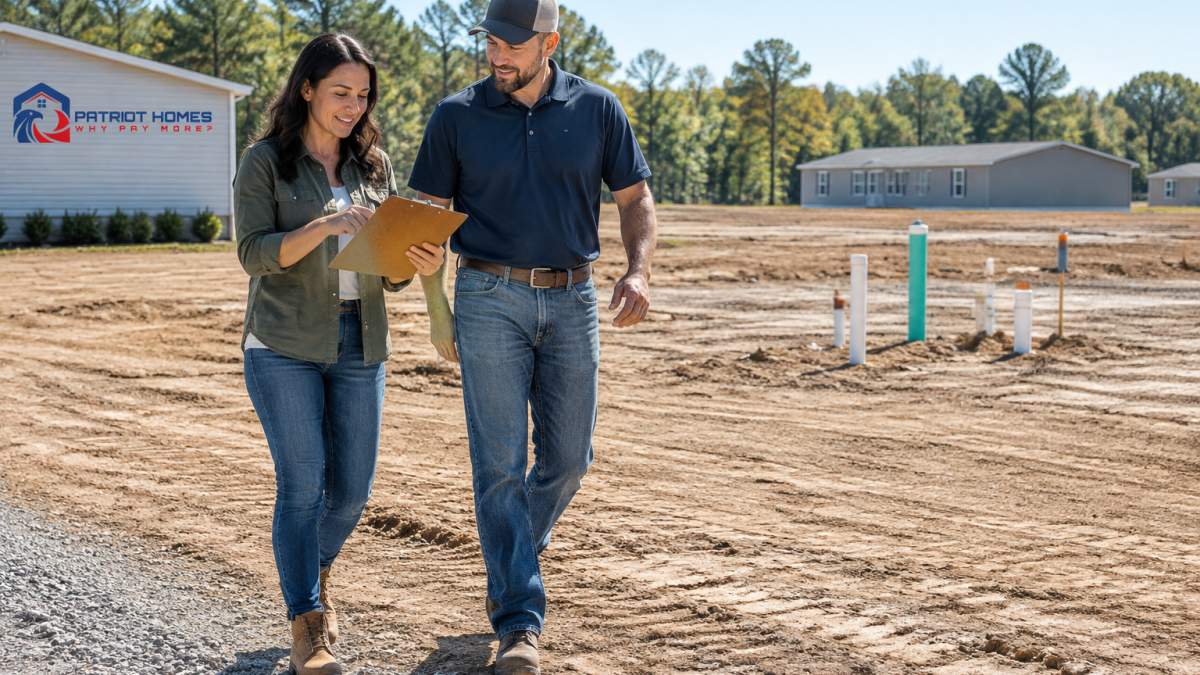
The critical path is the chain of tasks that controls your move-in date. If any task on that chain slips, everything after it slips with it. Most buyers track tasks as a flat list; the useful view is a sequence with dependencies, because some work can run in parallel and some cannot start until a prior approval lands.
What can run in parallel and what cannot
- Can run in parallel: zoning confirmation, delivery-route survey, and utility availability checks
- Must finish before clearing: zoning and legal access
- Must finish before grading: clearing and debris removal
- Must finish before foundation: grading, drainage plan, and soil compaction testing
- Must finish before delivery: pad readiness, utility stubs, and access-road completion
- Must finish before move-in: final inspections and utility connections
A common pattern is to start utility requests and permit applications while clearing and grading are underway, since utility scheduling and permit review often run on their own calendars and do not depend on the dirt work being finished.
Who owns which task
Timelines stall when nobody owns a step. A practical split looks like this:
- Buyer: confirm zoning and legal access, verify the delivery route, approve the site plan, schedule and pay contractors
- Retailer: coordinate the home order, delivery window, and set crew
- Site contractor: clearing, grading, drainage, compaction testing, foundation, access road
- Utility providers: water, sewer or septic, and electrical service connections and scheduling
- Local authorities: permit review, inspections, and final approval
Ask each party in writing which tasks they own. Gaps between owners are where weeks disappear.
Realistic durations and buffers
Exact timing varies by parcel, and clearing and grading can run longer on wooded or sloped ground. Permit review and utility scheduling are the two phases most likely to stretch beyond expectations because they depend on outside agencies. Build a buffer into the schedule rather than assuming best-case review times.
Delay scenarios and how to respond
- Failed inspection: the next phase cannot start until rework passes; keep a re-inspection slot open
- Unsuitable soil: compaction testing fails and the foundation design changes; budget time for re-engineering
- Utility delay: the connection date slips past pad readiness; confirm the utility’s schedule early and in writing
- Weather: rain or extreme heat halts crews; plan around seasonal patterns rather than fighting them
- Delivery-access problem: the transport cannot reach the pad; fix the route before the home ships, not after
Ordering the home against the critical path
The order date should be set against pad and utility readiness, not against the factory schedule alone. If the home is finished before the site is ready, it sits in storage, and storage costs money while the land catches up.
For help mapping your own critical path, call (888) 765-1776 for pricing matrices, customization options, or immediate assistance. Why pay more when you can have quality, style, and affordability all in one? You can also request a quote from our website.
The table below lays out the order of site phases and the dependencies that control your move-in date, as described in the critical path section.
| Phase | Must finish before | Can run in parallel |
|---|---|---|
| Zoning and legal access | Clearing | Delivery-route survey |
| Clearing and debris removal | Grading | Utility availability checks |
| Grading, drainage, soil compaction testing | Foundation | Permit applications |
| Pad readiness and utility stubs | Delivery | Utility scheduling |
| Access-road completion | Delivery | Permit review |
| Final inspections and utility connections | Move-in | None |
Manufactured Home Delivery and Setup: Coordinating the Final Schedule
Delivery and setup are the final steps, and they need close coordination. The transport company, the set crew, and your site contractor all need the same date. Confirm the delivery window in writing and make sure the pad and access road are clear.
Once the home is set, you will still have ongoing care to handle. Use this manufactured home maintenance checklist to plan seasonal upkeep for your roof, gutters, HVAC, and foundation.
Final connections and inspections can take extra time after setup. Ask your team for a realistic move-in date that includes these last steps.
Start Your Project: Call (888) 765-1776 or Request a Quote Online
A clear site timeline makes your move-in date far more predictable. Our team at Patriot Homes is available 24/7 to help you plan your project. Why pay more when you can have quality, style, and affordability all in one? We proudly serve local homeowners with custom manufactured and modular options, including 1-bedroom ADUs and spacious 4-bedroom floor plans.
Call us today at (888) 765-1776 for pricing matrices, customization options, or immediate assistance. Before you reach out, you can review how to buy a mobile home for sale in Palmdale, CA. You can also request a quote from our website. Our team is ready to walk you through every step.
Frequently Asked Questions
How long does it take to prep land for a manufactured home?
Site preparation duration depends on land condition and weather, so there is no single fixed answer. Clearing, grading, utility connections and inspections can each add time, and wet seasons can extend the schedule. Start site work early, and confirm the timeline with your Patriot Homes representative and local permitting office before ordering. For current pricing or a quote, call (888) 765-1776 or request one on our website.
What needs to be done before a manufactured home is delivered?
Before delivery, the site usually needs cleared access for the transport route, graded and drained ground, a prepared foundation or support system, and planned utility connections for water, sewer or septic, and electrical service. Permits and any required inspections should also be scheduled. Having these items ready prevents a delivered home from waiting on the lot. Our team can walk you through the checklist by phone at (888) 765-1776.
Can a manufactured home be delivered before the site is ready?
Factory construction can run on its own schedule, but delivery should not happen until the site is ready. Clayton Homes notes that site-preparation duration varies with land condition and weather, so a faster factory build does not guarantee the lot will be ready. Coordinating the factory schedule with site work is the most reliable way to avoid storage costs and delays. Call (888) 765-1776 to coordinate your delivery date.
