
Customizable Manufactured Homes for Small Budgets
Table of Contents
- Customizable Manufactured Homes for Small Budgets: What Your Money Buys
- Quick Comparison: Budget-Friendly Customizable Manufactured Homes
- How We Evaluated These Options
- Manufactured Home Floor Plans That Keep Costs Down
- Manufactured Home Customization Options That Fit a Budget
- Manufactured Home Upgrades Worth Paying For
- The Real Cost to Customize a Manufactured Home
- Which Option Fits Your Situation?
- Frequently Asked Questions
Last Updated: October 8, 2026
Customizable Manufactured Homes for Small Budgets: What Your Money Buys
Customizable manufactured homes for small budgets are factory-built houses that let buyers choose bedrooms, bathrooms, and finishes without paying custom-builder prices. At Patriot Homes, we work with first-time buyers across Arizona, California, Idaho, and Nevada who need a real home, not a stretch. According to AmeriSave’s manufactured home cost guide, new manufactured homes averaged about $123,300 in 2025, with factory-built construction running near $87 per square foot against roughly $166 for site-built. That gap is where a small budget finds room to breathe. Below, we’ll show you exactly which floor plans, customization options, and upgrades deliver the most home for the least money.
The smartest budget move is spending on structure and layout first, then finishes. You can swap a faucet later. You cannot move a wall.
Quick Comparison: Budget-Friendly Customizable Manufactured Homes
Three paths dominate the small-budget market, and they differ mainly in how much choice you get at what price. Manufactured homes give you the most customization per dollar. Small mobile homes keep upfront costs lowest. Modular builds land closest to site-built quality.
| Option | Typical Strength | Best For | Watch Out For |
|---|---|---|---|
| Customizable manufactured home | Layout and finish choices at factory pricing | Buyers who want personalization on a budget | Customization adds cost if you overdo it |
| Small mobile home | Lowest entry price, compact footprint | Single buyers, retirees downsizing | Fewer layout options |
| Modular starter home | Closest to site-built construction | Buyers who want a permanent feel | Base-unit pricing excludes land and site work |
The Homes Direct’s guide to small mobile homes notes that some small homes sell for under $50,000, which makes them a genuine entry point. Home Nation’s modular home price ranges lists a base-unit estimate of $80,000 to $150,000 for a roughly 1,000-square-foot starter home, though that figure excludes land and site preparation.
How We Evaluated These Options
We ranked each option on four factors that actually move a small budget: purchase price, how much of the home you can personalize, long-term value, and how much guidance you get during the process. Price matters most, but a cheap home you outgrow in three years is not cheap. Every option here was judged on total cost of ownership, not sticker price alone.
Ask any dealer for the “out-the-door” number: home, delivery, setup, utility hookups, and permits. The base price and the final price are rarely the same figure, and the gap is where budgets break.
Manufactured Home Floor Plans That Keep Costs Down
The floor plan drives cost more than any finish you pick. Square footage sets the base price, and every additional corner, bump-out, or hallway adds material and labor. Simple rectangles cost less to build, heat, and cool. Open plans with fewer interior walls also cut framing and finishing time, which shows up in your final number.
Small Footprints, Smarter Layouts
A 1,000 to 1,400 square foot home with two or three bedrooms covers most small-budget buyers. The trick is layout efficiency, not size. Look for plans where the kitchen, dining, and living areas share one open space, with bedrooms clustered on one end. That arrangement feels larger than its square footage and eliminates wasted hallway. MHCNB’s manufactured home floor plan comparison evaluates plans on affordability, customization, and energy efficiency together, which is the right way to judge them.
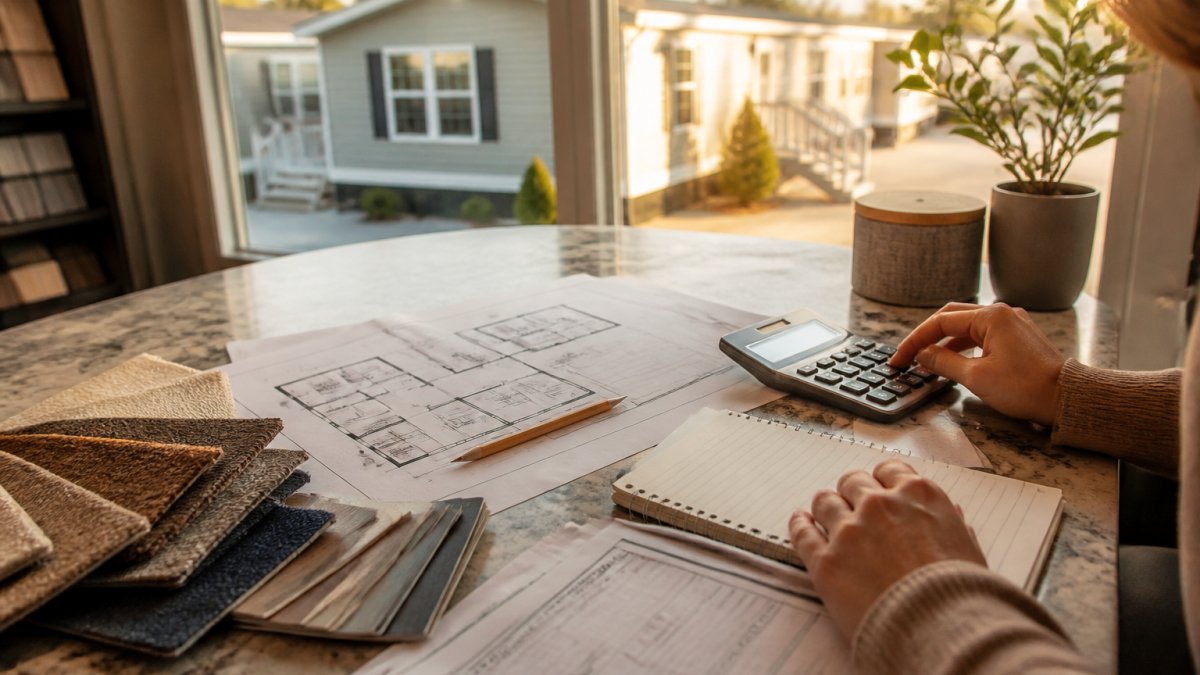
Manufactured Home Customization Options That Fit a Budget
Manufactured home customization options range from free to expensive, and knowing the difference protects your budget. Bedroom and bathroom counts, cabinet finishes, flooring, and exterior colors are the choices buyers make most often. Some cost nothing to change at the factory stage. Others add thousands.
Here is how we group the choices by budget impact:
- Low or no cost: interior wall color, cabinet hardware, carpet versus vinyl in the same grade, appliance package selection
- Moderate cost: flooring upgrades, countertop material, additional bedroom, covered porch
- Higher cost: layout changes, bump-outs, vaulted ceilings, custom cabinetry, premium siding
The single biggest mistake buyers make is choosing finishes before the layout. Lock the floor plan first. Then spend what remains on the finishes you touch every day.
Manufactured Home Upgrades Worth Paying For
Only a handful of manufactured home upgrades return their cost in daily use. Insulation and window quality top the list, because they cut monthly utility bills for as long as you own the home. A better appliance package ranks second, since replacing cheap appliances in year three costs more than upgrading at purchase. Flooring comes third, because quality flooring survives pets, kids, and traffic.
Where you can save: skip decorative trim packages, premium light fixtures, and upgraded cabinet pulls. These are easy to change later and add little to resale. Put that money into the building envelope instead.
Upgrading everything “while the factory is open” is how a small budget becomes a large one. Every add-on feels small alone. Together they can push a modest home past the price of a site-built alternative.
The Real Cost to Customize a Manufactured Home
The cost to customize a manufactured home depends on how far you move from the base plan, not on a flat rate. Simple finish swaps often cost little or nothing. Structural changes, added rooms, and premium materials carry real price tags. That is the opposite of traditional custom building, where nearly every deviation triggers a change order and a fee.
What Moves the Number Up or Down
Four factors decide your final price:
- Structural changes: moving walls or adding square footage costs the most
- Material grade: standard versus premium finishes on floors, counters, and cabinets
- Timing: changes made before production cost less than changes made after
- Site work: delivery, foundation, utility connections, and permits sit outside the home price
Ask for pricing on each upgrade as a line item. A dealer who will itemize gives you control. A dealer who only quotes a package total does not.
Which Option Fits Your Situation?
Match the home to your life, not to the brochure. A retiree downsizing needs a compact, low-maintenance plan with minimal stairs. A young family needs bedrooms and storage, even at the cost of finish quality. A landowner building on their own property needs a dealer who understands site preparation and delivery.
This is where Patriot Homes fits. We offer brand-new, customizable manufactured homes with many model options, from bedroom and bathroom counts to the finishes you choose. Our team is available 24/7 to walk you through the process, and we keep pricing competitive so a small budget still buys a home you are glad to live in.
Frequently Asked Questions
Can you customize a manufactured home?
Yes. Customizable manufactured homes let you choose bedrooms, bathrooms, layout, and finishes before the home is built. Dealers like Patriot Homes walk buyers through model options and personalization choices so the final home matches your needs. Because changes happen at the factory rather than on a job site, customization usually costs less than modifying a site-built home. Start by confirming which options your dealer offers, then set a budget before you select finishes.
How much does it cost to customize a manufactured home?
The cost to customize a manufactured home depends on which options you choose, the size of the home, and current material prices. Reported averages give context: a 2025 average new manufactured home price was $123,300, per AmeriSave, and some small mobile homes cost under $50,000, according to The Homes Direct. Patriot Homes lists pricing on its website, so you can see current figures and request a quote for your specific selections.
Are manufactured homes cheaper than site-built homes?
They usually are. AmeriSave reports factory-built homes at about $87 per square foot versus roughly $166 per square foot for site-built homes. That gap comes from factory construction, bulk material buying, and controlled build conditions. For buyers on small budgets, this difference often decides whether homeownership is possible at all. Keep in mind the per-square-foot figure is an average and your total also includes land, delivery, and site preparation.
What upgrades are worth paying for in a manufactured home?
Prioritize upgrades that are hard or expensive to change later: insulation and energy-efficient windows, a reinforced foundation setup, and quality flooring in high-traffic areas. Cosmetic items like light fixtures, paint colors, and cabinet hardware can be swapped after move-in for less money. Ask your dealer which manufactured home upgrades affect long-term utility bills and maintenance, then spend your budget there first.
How can I keep manufactured home costs down?
Choose a smaller floor plan, keep the layout close to a standard model, and limit structural changes. Focus customization on a few high-impact finishes instead of upgrading everything. Compare base-unit pricing, like the $80,000 to $150,000 range Home Nation cites for a roughly 1,000-square-foot starter home, against your total budget including delivery and site work. Patriot Homes offers 24/7 support to help you weigh options before you commit.
The hard part of buying on a small budget is not finding a home. It is knowing which choices add value and which just add cost. Get that wrong and you overspend on trim while underinvesting in insulation. Patriot Homes builds customizable manufactured homes with the layout, finish, and model options that let you decide where every dollar goes, backed by 24/7 support and pricing built for first-time buyers. Contact us now to start your build and see how far your budget actually reaches.