
7 Hidden Costs of Buying a Manufactured Home
Last Updated: November 7, 2026
Quick Summary
The hidden costs of buying a manufactured home include land or lot rent, site preparation, delivery and setup, utility hookups, skirting, steps, permits, and recurring taxes and insurance. These costs sit on top of the home’s price, so the listing price is rarely your final total. Add each one to your budget before you sign.
- Site preparation costs vary most, depending on slope, soil, access, and local code.
- Ask contractors to quote site work line by line to compare bids and spot missing items.
- Lot rent can reset annually and is set by the community, not your lender.
- Taxes and insurance depend on how the home is titled, so confirm them before you sign.
- Build a replacement reserve tied to major components like roof, HVAC, and water heater.
Table of Contents
- Why the Listing Price Is Only the Starting Point
- Land, Lot Rent, and Where the Home Will Sit
- Manufactured Home Site Preparation Costs
- Cost of Manufactured Homes Installed: Delivery, Setup, and Utilities
- Mobile Home Cost Per Month: Lot Rent, Taxes, Insurance, and Repairs
- Building a Realistic Budget with a Hidden Costs Calculator
- Next Step: Call (888) 765-1776 for Pricing and Customization Options
- Frequently Asked Questions
Why the Listing Price Is Only the Starting Point
The price on the listing is rarely what you will spend.
Here is the core problem. The home itself is only one piece of the total.
Pricing depends on the home’s size, the layout you choose, and the options you select, so the total will vary from one project to the next.
The real budget covers everything that gets the home livable on your property.
Call (888) 765-1776 any time, day or night, to talk through your numbers with our team. We are available 24/7 to help you build a realistic plan.
Land, Lot Rent, and Where the Home Will Sit
Your land decision shapes your monthly costs more than almost anything else.
If you buy land, the purchase price is a separate cost from the home.
If you rent a lot, you will pay lot rent every month.
Many buyers also overlook the cost of preparing their own land. Our guide on how to prepare land for a manufactured home walks through site assessment, permits, grading, and utilities.
Owning the land you place the home on works differently. You may need to pay property taxes on the land and on the home, depending on how the home is titled and taxed. Putting a manufactured home on your own land covers the steps for that setup.
If you plan to finance, confirm early how the home will be titled and taxed, since this affects which loan options are available.
Manufactured Home Site Preparation Costs
Site preparation is one of the most common budget gaps, and it is also the line item that varies most from one property to the next. Two lots of the same size can carry very different site-work bills depending on slope, soil, access, and local code. Understanding what drives the number helps you sanity-check contractor quotes before you commit.
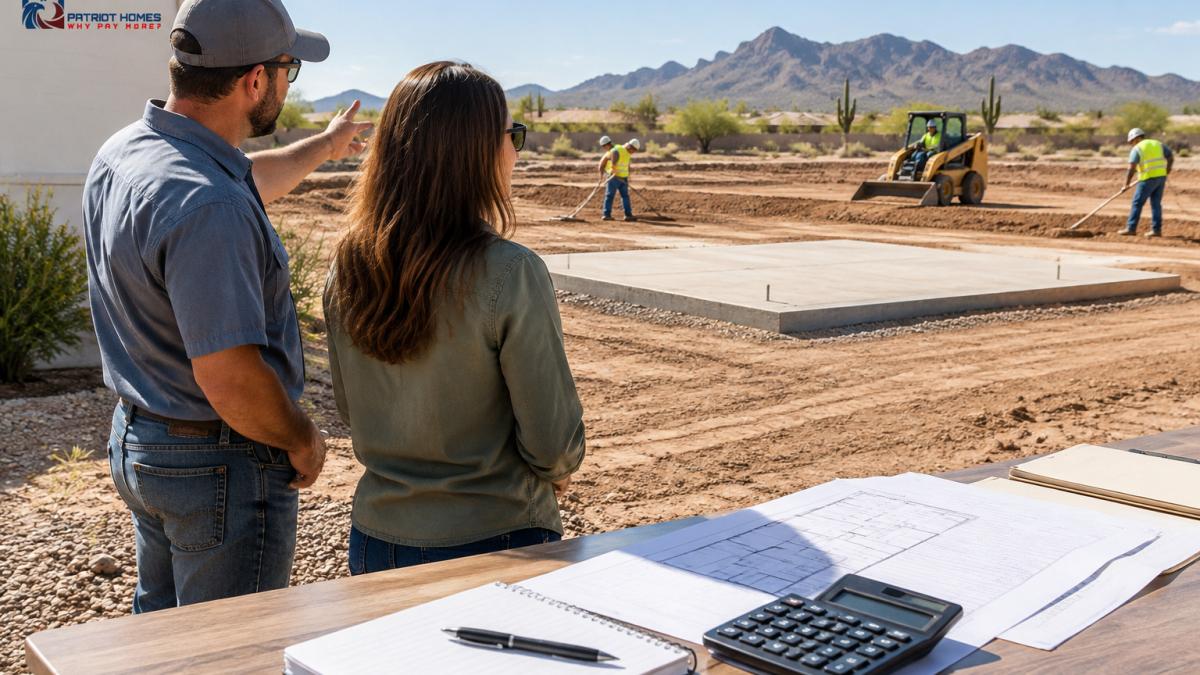
Site work typically breaks into these components:
- Clearing and grading, removing trees, brush, and rock, then cutting and filling the pad to a level building surface
- Foundation system, a poured concrete slab, a perimeter stem wall, or a pier-and-anchor system, depending on code and whether the home will be titled as real property
- Anchoring and tie-downs, ground anchors, straps, and stabilizers sized to the home and to local wind and seismic requirements
- Utility trenching, digging and backfilling runs for water, sewer or septic, electric, and gas
- Access and driveway, a gravel or concrete path wide and strong enough for the delivery truck and the home itself
- Drainage, grading away from the pad, swales, or French drains so water does not pool under the home
What Drives the Cost Up or Down
A flat, dry, open lot with utilities already at the street is the low-cost case. Costs climb when:
- The site is sloped and needs retaining walls or significant cut-and-fill
- The soil is rocky, expansive clay, or has a high water table
- The lot is landlocked or the access road cannot handle a transporter
- Utilities are far from the pad and need long runs or a new well and septic system
- The jurisdiction requires engineered foundation plans, soils reports, or special inspections
The foundation and anchoring line is often underestimated, because the requirement depends on how the home will be titled and financed. Foundation and installation requirements are typically set at the state and local level, so site work can differ from one county to another.
Get Site Quotes in Writing, Line by Line
Ask each contractor to quote the components separately rather than as one lump sum. A line-item quote lets you compare bids, spot the item a low bidder left out, and see which costs are fixed versus which depend on what they find once digging starts.
Watch out: a quote that excludes permits, engineering, or utility connection fees is not the full site cost, and those items often land after you have already committed to the home.
Our team works with homeowners across the region and can walk you through the installation steps that tend to drive the most work on your type of lot.
Cost of Manufactured Homes Installed: Delivery, Setup, and Utilities
Delivery, setup, and utility connections are separate from the home itself and add to the total cost.
Delivery is often billed by distance and by the size of the home. Installation covers leveling, anchoring, and joining sections for multi-section homes. Utility hookups connect water, sewer or septic, and electricity, and each one has its own cost.
Some items get left out of early estimates:
- Skirting around the base of the home
- Steps and a porch or deck at each entry
- Permit and inspection fees
- Connection fees for water and sewer
Also expect that some of these charges will land after closing. Plan for them now.
Mobile Home Cost Per Month: Lot Rent, Taxes, Insurance, and Repairs
Your monthly cost of owning a manufactured home goes well beyond the mortgage or loan payment. The recurring items below are where the long-term affordability of a manufactured home is actually decided, and where a land-ownership decision changes the math the most.
Plan for these monthly and yearly costs:
- Lot rent, charged if you live in a manufactured-home community; it can reset annually and is set by the community, not by your lender
- Property taxes, depend on the land, the home, and how the home is titled and classified in your jurisdiction
- Insurance, required by most lenders and sensible for any owner; premiums reflect the home’s age, construction, and site
- Utilities, water, sewer or septic, electric, gas, and trash
- Repairs and updates, part of ownership for any home, but the timing is predictable enough to budget for
Land Ownership vs. Community Living: The Recurring-Cost Tradeoff
This is the comparison most buyers never run before they sign. Renting a lot in a community keeps your upfront cash lower and bundles some services, but the lot rent is a recurring cost you do not control and do not build equity in.
A practical way to compare the two: add up twelve months of lot rent plus any community fees, then compare that to twelve months of land taxes, land insurance, and land maintenance on a lot you would otherwise buy.
Build a Replacement Reserve, Not Just a Repair Fund
A generic “save for repairs” habit is not enough. Manufactured homes have a predictable lifecycle for major components, and a reserve plan that maps to that lifecycle keeps a roof or HVAC replacement from becoming a crisis.
One approach is to set aside a fixed monthly amount and tag it to a schedule:
- Roof, plan for replacement on the shingle or membrane manufacturer’s rated life, and inspect annually for sealant and flashing wear
- HVAC, budget for service visits and eventual replacement; filters and coil cleaning are the cheap preventive items
- Water heater and appliances, these fail on their own schedule; a reserve covers the swap without a loan
- Exterior, skirting, steps, decks, and sealants need periodic repair and repainting, and neglected exterior work is what usually shows up in resale
- Foundation and anchoring, inspect tie-downs and piers periodically, especially after severe weather
A reserve sized to these items is more useful than a single emergency fund, because it tells you when the big-ticket year is coming instead of surprising you.
Taxes and Insurance Depend on How the Home Is Titled
Insurance and taxes vary by location and by how the home is titled, so ask for quotes before you commit. A home titled as personal property (chattel) is taxed and insured differently from one titled as real estate with the land, and that classification also affects which loan programs you can use. A guide to manufactured home taxes and insurance explains what to expect.
Watch out: a lot-rent increase or a reclassification of the home can change your monthly number after closing, so confirm both in writing before you sign.
Our team can help you compare the land-ownership and community scenarios side by side and price the floor plans that fit your budget. Call (888) 765-1776 for a pricing matrix or immediate help, and request a quote from our website.
The recurring costs below are where long-term affordability is decided, so compare them side by side before you sign.
| Monthly or yearly cost | What it covers | Key note |
|---|---|---|
| Lot rent | Community lot fee | Can reset annually; set by the community |
| Property taxes | Land and home | Depend on how the home is titled |
| Insurance | Home coverage | Reflects age, construction, and site |
| Utilities | Water, sewer, electric, gas, trash | Recurring monthly bills |
| Repairs and updates | Routine upkeep | Timing is predictable enough to budget |
Building a Realistic Budget with a Hidden Costs Calculator
A clear budget is the best defense against surprise bills. Start with the home price, then add every cost that comes after it.
Use this checklist to build your total:
- Home purchase price
- Land purchase or lot rent
- Site preparation and foundation
- Delivery and installation
- Utility hookups
- Skirting, steps, and porch
- Permits and inspections
- Insurance and property taxes
- Monthly utilities and maintenance reserve
Once you have the list, fill in a quote for each line. Compare that total against what you can afford each month.
Add a contingency buffer to your estimate. Final costs often run higher than the first estimate, so a cushion helps protect your budget.
Our team can help you fill in pricing for the floor plans and customization options you want. Call (888) 765-1776 for a pricing matrix, or request a quote on our website.
Next Step: Call (888) 765-1776 for Pricing and Customization Options
Knowing the hidden costs of buying a manufactured home puts you in control of the process. Start by listing your land options, site costs, and monthly expenses so you know your true budget.
Patriot Homes offers many floor plans, from 1-bedroom ADUs to spacious 4-bedroom models. Why pay more when you can have quality, style, and affordability all in one? We proudly serve local homeowners with custom manufactured and modular options.
Call us at (888) 765-1776. Our team is available 24/7 for pricing matrices, customization options, or immediate help. You can also request a quote from our website.
Frequently Asked Questions
What is the downside to buying a manufactured home?
The main downside is that buyers often underestimate the total cost. The listing price usually excludes land or lot rent, site preparation, foundation work, delivery, installation, utility connections, and exterior additions such as skirting, steps, and decks. Ownership expenses like insurance, property taxes, and repairs also add up over time. Financing can be more restrictive when the home is not titled and taxed as real estate. Planning for these items before you sign protects your budget. Patriot Homes can review your plans with you; call (888) 765-1776 or request a quote on our website.
How much does it cost to install a manufactured home?
Installation costs depend on the site, the foundation type, the distance for delivery, and the utility connections needed. Site preparation, foundation work, anchoring, and utility hookups are typically separate from the home price, so they should be budgeted as their own line items. Local permits and inspections can also add to the total. Because these costs vary by location and property, get a written estimate for your specific lot. Call Patriot Homes at (888) 765-1776 for pricing matrices and assistance with your installation planning.
What costs should I budget for when buying a manufactured home?
Budget for the home itself, land or lot rent, site preparation and grading, foundation and anchoring, delivery and setup, utility connections, permits, skirting, steps, and decks. Also reserve money for insurance, property taxes, routine maintenance, and unexpected repairs. Building a contingency of several percent beyond your estimate helps absorb surprises. Our team can walk you through each category; call (888) 765-1776 any time, day or night, or request a quote from our website.
