
Manufactured Homes With High Quality Finishes: 2026 Guide
Table of Contents
- What High Quality Finishes Actually Mean in a Manufactured Home
- Manufactured Home vs Site Built Cost Comparison
- Luxury Manufactured Home Interior Design Ideas
- Durable Materials for Manufactured Home Upgrades
- Top Manufacturers and Dealers for High Quality Finishes
- Resale Value and Financing Upgrades
- Conclusion
- Frequently Asked Questions
Last Updated: September 24, 2026
What High Quality Finishes Actually Mean in a Manufactured Home
High quality finishes in a manufactured home are the interior and exterior materials that go beyond the HUD Code minimum: quartz or solid-surface countertops, hardwood or luxury vinyl plank flooring, upgraded cabinetry with soft-close hardware, and architectural details that make a factory-built house read like a custom site-built one.
HUD Code compliance is mandatory and identical across manufacturers. Finish quality is the variable you actually control, and it is where most of your upgrade budget should go.
HUD Code Baseline vs. Premium Upgrades
The HUD Code governs structural integrity, fire safety, electrical, and plumbing. It says nothing about whether your kitchen has particleboard or plywood cabinets.
Premium upgrades typically fall into four buckets:
- Surfaces: quartz countertops, solid-surface vanities, tile backsplashes
- Flooring: hardwood, engineered wood, luxury vinyl plank
- Cabinetry: custom cabinetry, soft-close drawers, upgraded hardware
- Fixtures: designer lighting, upgraded faucets, energy-efficient windows
Manufactured Home vs Site Built Cost Comparison
A manufactured home typically costs less per square foot than a site-built home of similar size, largely because factory construction removes weather delays, reduces material waste, and standardizes labor. The manufactured home vs site built cost comparison is not really about the sticker price, it is about where the savings come from and how much you reinvest in finishes.
Where the Savings Come From
Factory construction compresses the build timeline, materials are bought in volume, and assembly happens indoors so weather does not stall the schedule. Those three factors drive most of the price difference.
How Upgrades Change the Math
Most buyers assume a manufactured home is cheap, then are surprised when a fully loaded model costs meaningfully more than a base one. That is not a bait-and-switch, it is the same dynamic as site-built construction: the structure is one line item, the finishes another.
Comparing a base-model manufactured home price against a fully upgraded site-built quote is an apples-to-oranges mistake. Always compare like finish levels, or you will misjudge the real savings.
Luxury Manufactured Home Interior Design Ideas
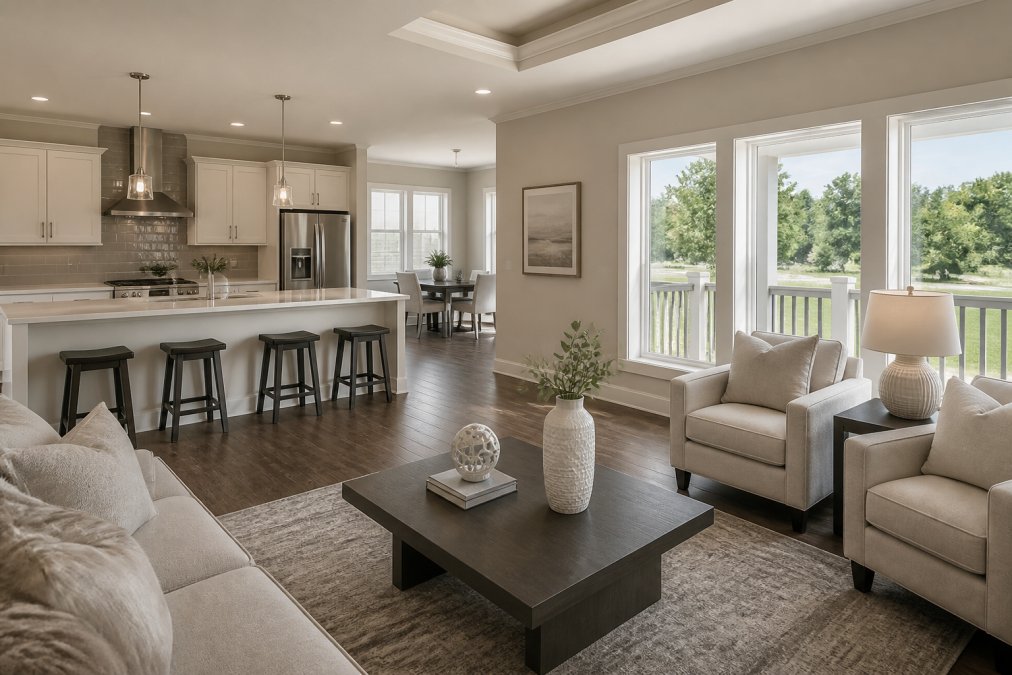
Luxury manufactured home interior design ideas start with layout, not materials. An open-concept floor plan with a clear sightline from kitchen to living space does more for perceived quality than any single finish upgrade.
Open-Concept Layouts and Flow
Open-concept design is now standard in premium manufactured floorplans: removing interior walls makes a smaller footprint feel larger and lets natural light travel further.
Finishes That Read as Custom, Not Cookie-Cutter
The tell on a cheap build is repetition, every home on the lot has the same cabinet color, backsplash, and fixtures. Breaking that pattern is easier than most buyers expect: mixing cabinet finishes between kitchen and bathrooms, choosing a non-standard backsplash, and upgrading lighting are low-cost moves that change how a home reads.
Durable Materials for Manufactured Home Upgrades
Durable materials for manufactured home upgrades survive humidity swings, temperature shifts, and daily wear without constant repair, especially in the western states where Patriot Homes works. “Durable” maps to specific material properties and maintenance schedules that separate a finish lasting 20 years from one that looks tired in five.
What Makes a Finish Durable, Mechanically
Four properties drive longevity in a factory-built home:
- Moisture resistance. Kitchens, bathrooms, and laundry rooms see repeated wet-dry cycles. Materials that swell, delaminate, or grow mold when wet fail first.
- Dimensional stability. Factory-built homes are transported over the road and set on foundations that may shift in the first year. Materials that expand and contract with temperature and humidity, solid hardwood, some tile, can crack or gap if not acclimated and installed correctly.
- Surface hardness. Scratch and impact resistance determines how a finish looks after a decade of daily use.
- Repairability. A finish you can spot-repair beats one that requires full replacement.
Material-by-Material Breakdown
Countertops. Quartz is an engineered stone, roughly 90-95% ground quartz mixed with resin, making it non-porous and stain-resistant without sealing. Granite is porous natural stone and needs resealing, typically annually. Laminate is the budget option and the first to show burns, chips, and seam swelling.
Maintenance Schedules for Premium Finishes
High-end finishes do not eliminate maintenance, they change it.
- Quartz: wipe daily with mild soap and water; avoid abrasive pads and harsh chemicals. No sealing required.
- Granite and other natural stone: reseal annually; wipe spills promptly, especially oil and acidic liquids.
- Engineered and solid hardwood: sweep or vacuum weekly; use felt pads under furniture; keep indoor relative humidity roughly between 35% and 55% to limit gapping and cupping.
- LVP: damp-mop with manufacturer-approved cleaner; avoid steam mops, which can force moisture into seams.
- Plywood cabinetry: wipe spills inside boxes promptly; check under-sink areas seasonally for leaks.
- Windows and HVAC: replace filters on schedule; inspect weatherstripping and caulk annually.
Ask for the cabinet box material in writing. Many “upgraded cabinetry” packages still use particleboard boxes with upgraded doors. The doors are what you see; the boxes are what fail.
How Durability Interacts With the HUD Code
The federal HUD Manufactured Home Construction and Safety Standards sets minimum performance requirements for the structure, electrical, plumbing, and fire safety. It does not set minimums for countertop material, cabinet box construction, or flooring wear layer. That means two homes can both be fully HUD-compliant while one uses builder-grade laminate and the other uses quartz and plywood.
Climate Considerations
In hot, dry regions, wood products shrink and gaps open, while engineered products handle the swing better. In humid regions, moisture management matters more, ventilation, vapor barriers, and mold-resistant substrates. In cold regions, window and insulation performance drives comfort and monthly cost. Match the material to the climate, not the showroom.
Top Manufacturers and Dealers for High Quality Finishes
The best manufacturer for high quality finishes depends on whether you want a dealer who handles customization end to end or a factory-direct builder with a fixed catalog.
| Option | Best For | Standout Strength | Watch Out For |
|---|---|---|---|
| Patriot Homes | Custom finish selection on a budget | 24/7 support, wide model range | Confirm land and site prep early |
| Skyline Homes | Structural durability focus | Strict quality assurance | Limited pricing transparency |
| Next Modular Homes | Hands-off turnkey builds | Full project management | Service area can be limited |
| Oasis Homes | All-inclusive packages | Integrated design and build | Requires local contractor coordination |
Patriot Homes
Patriot Homes is a dealer of brand-new, customizable manufactured homes, and the strongest fit for buyers who want control over finishes without a custom-builder price tag. You choose the number of bedrooms and bathrooms, then select the finishes that matter to you. Customization happens before the build, not through change orders after.
Skyline Homes
Skyline Homes leans into structural integrity and quality control, attracting buyers who care most about how the home is built rather than how it is styled. The tradeoff is pricing transparency: you generally need to contact them for a quote.
Next Modular Homes
Next Modular Homes runs a turnkey model: you hand over the project and they manage it. That reduces stress but also reduces your control over finish selections, and their service area is narrower than a national brand’s.
Oasis Homes
Oasis Homes bundles design and build into all-inclusive packages, suiting buyers who want one point of contact. Site work still requires coordination with local contractors, so “all-inclusive” has limits.
Resale Value and Financing Upgrades
Manufactured homes can hold value when titled as real property, placed on a permanent foundation, and finished to a standard comparable with surrounding site-built homes. The depreciation worry most buyers carry comes from older mobile homes on leased land, not modern manufactured homes on owned property.
The Three Conditions That Drive Resale
- Land ownership and foundation type. A home on owned land with a permanent foundation appraises differently than one on a rented pad. Lenders and appraisers treat these as different asset classes.
- Titling. A manufactured home can be titled as personal property (like a vehicle) or as real property (like a site-built house). Real-property titling, sometimes called “conversion” or “surrender of title”, generally requires the home to be permanently affixed to owned land, and opens access to conventional mortgage products and better resale outcomes.
- Finish level relative to the neighborhood. Over-upgrading past local comparables rarely pays back. A quartz-and-hardwood home surrounded by laminate-and-carpet comparables will not appraise at its full finish cost.
How Appraisers Actually Value Upgrades
Appraisers do not price finishes line by line. They compare your home to recent sales of similar homes (comparables) and adjust for differences, so the return on a finish upgrade depends on whether comparable homes in your market also have it. If they do, the upgrade is expected and adds little premium; if they do not, it may not be fully credited.
Financing Premium Upgrades
Most buyers assume upgrades must be paid out of pocket, but several loan structures can absorb them:
- FHA Title I loans are insured by the Federal Housing Administration and can be used for manufactured home purchases and certain improvements. FHA also insures loans on manufactured homes that meet specific requirements, including permanent foundation standards.
- VA loans are available to eligible veterans, service members, and surviving spouses for manufactured homes that meet VA requirements, including real-property titling and permanent foundation standards.
- USDA Section 502 loans through the U.S. Department of Agriculture support rural homeownership and can include manufactured homes that meet program requirements.
- Conventional loans (Fannie Mae and Freddie Mac programs) generally require real-property titling and permanent foundation compliance for manufactured homes.
- Chattel loans are personal-property loans for manufactured homes not titled as real property. They typically carry higher interest rates and shorter terms than mortgages, which is a major reason real-property titling matters.
Financing terms differ significantly between chattel loans and real-property mortgages. Before you commit to a finish package, confirm which loan type you qualify for and whether your chosen titling path supports it.
What Actually Pays Back
Buyers commonly report that structural and efficiency upgrades, insulation, windows, HVAC, foundation, hold value more reliably than cosmetic ones, because they affect operating cost and insurability. Cosmetic finishes (backsplash, paint, lighting) are more personal and less reliably credited at resale. Prioritize performance items, then layer cosmetics on top within your budget.
A Practical Sequence
- Confirm land ownership and titling path first.
- Confirm which loan type you qualify for and what it allows.
- Set your finish budget against local comparables, not a national average.
- Prioritize performance upgrades (insulation, windows, HVAC) before cosmetics.
- Document every upgrade in writing for the appraiser.
Conclusion
The gap between a base manufactured home and one with genuine high quality finishes comes down to choices made before construction starts, not repairs afterward. Get those choices right and the home performs better, costs less to maintain, and holds value longer.
Frequently Asked Questions
What are the most durable interior finishes for manufactured homes?
Quartz countertops, luxury vinyl plank or hardwood flooring, and solid wood or plywood cabinetry hold up best in manufactured homes. These materials resist moisture, scratches, and daily wear better than laminate or particleboard. They also maintain their appearance longer, which matters if you plan to sell. When choosing durable materials for manufactured home upgrades, prioritize surfaces that handle humidity and temperature swings common in factory-built homes.
Do high-quality finishes increase the resale value of a manufactured home?
Yes, premium finishes can improve resale value by making your home more competitive in the local market. Buyers often pay more for homes with quartz countertops, hardwood flooring, and upgraded cabinetry because these features signal better overall construction. However, the return depends on your area and how your home compares to similar listings. Focus on finishes that appeal to a broad range of buyers rather than highly personal choices.
Can I customize the finishes in a new manufactured home?
Most manufacturers and dealers let you choose finishes during the ordering process. You can typically select flooring, countertops, cabinetry, paint colors, and fixtures. Some builders offer design centers where you see and touch samples before deciding. If you want luxury manufactured home interior design ideas, ask your dealer for an upgrade list with pricing so you can budget accurately. Customization is one of the main advantages of buying new versus used.
What is the difference between standard and premium manufactured home finishes?
Standard finishes use builder-grade materials like laminate countertops, vinyl flooring, and particleboard cabinets. Premium finishes upgrade to quartz or granite counters, hardwood or luxury vinyl plank flooring, and solid wood cabinetry. Premium packages also often include better insulation, energy-efficient windows, and higher-end plumbing fixtures. The gap in durability and appearance is noticeable, and premium finishes usually add to the upfront cost but reduce long-term maintenance.
How does the cost of a manufactured home with high quality finishes compare to a site-built home?
A manufactured home with high quality finishes typically costs less per square foot than a comparable site-built home. Factory construction reduces labor and material waste, and you avoid weather delays. Even after adding premium upgrades, many buyers find the total price remains below site-built alternatives. For an accurate manufactured home vs site built cost comparison in your area, request quotes from dealers and local builders, then compare the full scope of what is included.