
Raw Land vs Developed Lots: What Buyers Must Know
Last Updated: November 4, 2026
Quick Summary
Raw land vs developed lots comes down to readiness: raw land is undeveloped property with no roads, utilities, or grading, while a developed lot is prepared so a home can be placed on it now. Raw land has a lower purchase price, but development costs often narrow that gap. Buyers commonly wait 12 to 24 months on raw land, versus 6 to 9 months on a developed lot.
- Raw land has no roads, utilities, or grading; developed lots have them in place.
- Price out survey, access, water, sewer, power, and site work before making an offer on raw land.
- A utility line near a parcel is not confirmed service; get written availability and capacity.
- Raw land commonly takes 12 to 24 months to reach move-in, versus 6 to 9 months for a developed lot.
- Verify zoning, easements, and legal road access before closing on any parcel.
Table of Contents
- Raw Land vs Developed Lots: Core Definitions
- Upfront Price Versus Total Development Cost
- Utility Hookups for Manufactured Homes: Water, Sewer, Power
- Site Preparation for Modular Homes and Access
- Timelines From Purchase to Move-In
- Permits, Zoning and Due Diligence Checklist
- Choosing the Right Lot for Your Patriot Home
- Frequently Asked Questions
Raw Land vs Developed Lots: Core Definitions
When comparing raw land vs developed lots, raw land is undeveloped property with no roads, utilities, or grading, while a developed lot has been prepared so a home can be built on it now. If you’re shopping for a manufactured home in Arizona, California, Idaho, or Nevada, that difference drives your budget, your timeline, and your risk.
Raw land usually sits in its natural state. A developed lot has road access, utility connections, and a level building pad. Many buyers also use the term “improved land,” which can mean partially prepared. Check with the county and your local planning office, because the exact meaning of “developed” varies by jurisdiction. U.S. Census Bureau housing and land data
We proudly serve local homeowners across the Western US, and we offer both custom manufactured and modular options. Our floor plans range from 1-bedroom ADUs to spacious 4-bedroom models. Why pay more when you can have quality, style, and affordability all in one?
Upfront Price Versus Total Development Cost
Raw land almost always carries a lower purchase price per acre than a developed lot. That lower sticker price is why many buyers start there.
A useful way to compare parcels is a line-item development worksheet. The categories below are the ones most practitioners price out before making an offer.
- Survey and boundary work: an ALTA or boundary survey, plus a topographic survey if grading is planned
- Legal access: recorded easements, a shared road maintenance agreement, or a new driveway built to county standards
- Water: a well (drilling, pump, pressure tank, water quality testing) or a municipal tap and meter
- Wastewater: a septic system (soil percolation testing, design, permit, installation) or a municipal sewer tap and connection
- Power: a service extension from the nearest utility line, plus a meter and service panel sized for the home
- Site work: clearing, grading to a buildable pad, erosion control, and drainage
- Permits and fees: building, grading, septic, well, and utility connection permits, plus any school or impact fees the jurisdiction charges
- Carrying costs: property taxes, insurance, and loan interest while the lot sits undeveloped
Sequence matters as much as the line items. A failed percolation test can eliminate septic as an option, and a survey can reveal that the legal access you assumed is actually a neighbor’s driveway.
Watch out: A low per-acre price can hide a high total.
Financing, insurance, and taxes also shift with land type. Lenders often treat raw land differently from a developed lot, so ask about down payment requirements, loan terms, and underwriting for unimproved parcels.
Our team can help you think through how these categories apply to a manufactured or modular placement on your specific parcel. Call (888) 765-1776 for pricing matrices and customization options, or request a quote from our website.
The table below lists the development categories the article says buyers should price out before making an offer on raw land.
| Category | What it covers | Key note |
|---|---|---|
| Survey and boundary work | ALTA or boundary survey, topographic survey if grading is planned | Confirms boundaries |
| Legal access | Recorded easements, shared road agreement, or new driveway | Must be legal, not assumed |
| Water | Well or municipal tap and meter | Varies by parcel |
| Wastewater | Septic system or municipal sewer connection | Soil testing may limit options |
| Power | Service extension, meter, and service panel | Distance drives cost |
| Site work | Clearing, grading, erosion control, drainage | Depends on terrain |
| Permits and fees | Building, grading, septic, well, utility permits, impact fees | Jurisdiction-specific |
| Carrying costs | Property taxes, insurance, loan interest while undeveloped | Ongoing until move-in |
Utility Hookups for Manufactured Homes: Water, Sewer, Power
Utilities decide whether a manufactured home can be occupied on day one. A developed lot usually has water, sewer, and power at the property line. Raw land usually does not. The gap most buyers miss is that a utility line running near a parcel is not the same as confirmed service. Distance, capacity, and provider approval all have to line up before you can count on a connection.
Your manufactured home needs three connections:
- Water: municipal supply or a private well
- Sewer: municipal sewer or an on-site septic system
- Power: a grid connection with a service panel sized for the home
Nearby Line vs. Confirmed Service
A line visible from the road tells you almost nothing. What matters is whether the provider will serve your specific parcel, at what capacity, and under what terms. Most practitioners verify four things in writing before closing:
- Availability: the provider confirms service can be extended to the parcel
- Capacity: the existing main or transformer can carry the load your home requires
- Connection cost: the provider quotes the extension, tap, meter, and any upgrade charges
- Approval: you receive written confirmation, not a verbal estimate from a call center
A common pattern is a parcel where the water main ends a few hundred feet short, or where the transformer serving the street is already at capacity. Either situation can turn a routine hookup into a major project. Get the provider’s answer in writing and keep it with your closing documents.
Well and Septic Versus Municipal Connections
Municipal water and sewer are typically faster and more predictable than wells and septic systems, but they depend on the main being in the street and the provider having capacity. A well requires a driller, a water test, and a pump. A septic system requires soil testing, a permit, and an installer.
On rural raw land, the nearest main may be far away, and extending it can cost far more than the land itself. Read our guide to alternatives to traditional septic systems for rural land to see which options exist and what they typically cost to install.
Watch out: A verbal “service is available” from a utility representative is not the same as a written commitment. Capacity, fees, and extension requirements can change between the call and the closing.
Our team can help you think through placement questions for your specific home before you buy. Call our 24/7 team at (888) 765-1776 for pricing matrices, customization options, or immediate assistance, or request a quote from our website. We proudly serve local homeowners with custom manufactured and modular options, with floor plans from 1-bedroom ADUs to spacious 4-bedroom models.
Site Preparation for Modular Homes and Access
Site preparation is the work that turns raw ground into a buildable pad. It includes clearing vegetation, grading the surface so water drains away, and building a stable access road. Modular homes and manufactured homes both need a level, well-drained foundation.
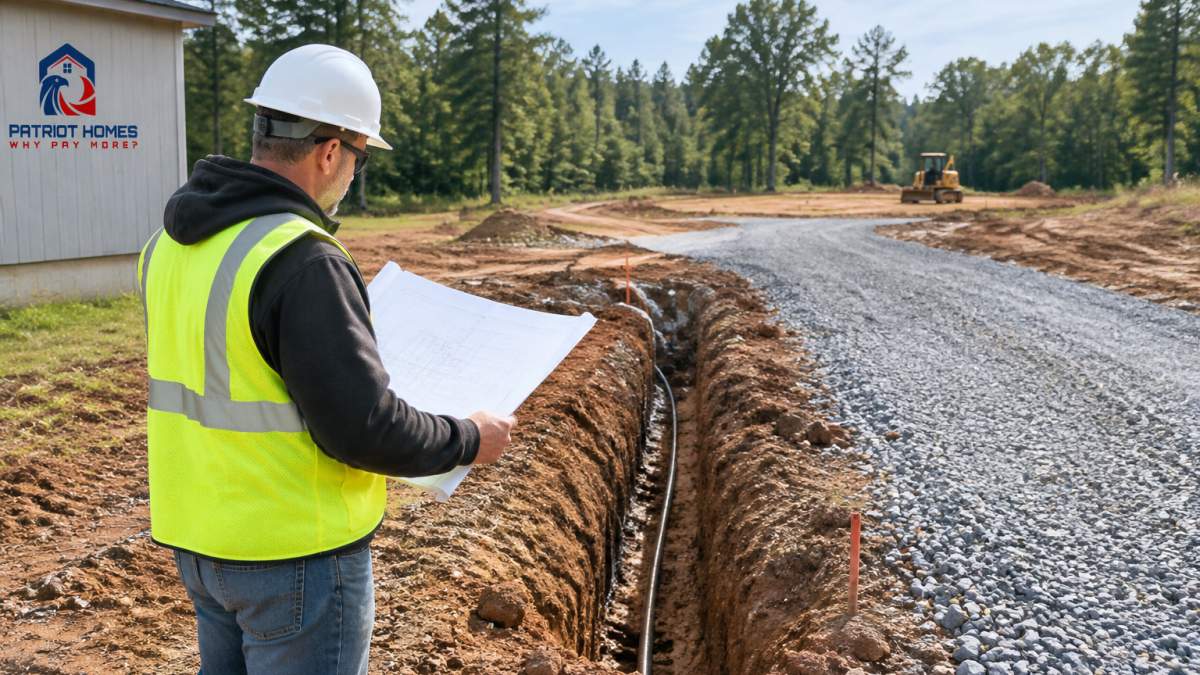
Access matters as much as the pad itself. Delivery trucks carrying a home need a route wide enough and strong enough to carry the load. Confirm that your parcel has legal access, not just a path across a neighbor’s property. Your land survey will show boundaries and easements. Our guide to land survey costs for residential property explains what a survey covers before you commit to site work. Land survey and boundary basics
Site work costs vary with terrain, soil, and the amount of clearing required. Get a bid from a licensed site contractor who knows your county’s requirements.
Timelines From Purchase to Move-In
Timing is where raw land and developed lots differ most. Based on industry estimates, buyers of raw land commonly wait 12 to 24 months from purchase to move-in. A developed residential lot commonly takes 6 to 9 months. Residential development timeline comparison
The longer raw land timeline comes from several steps that run in sequence:
- Survey and due diligence
- Permit applications and approvals
- Utility installation
- Site preparation and grading
- Home delivery and setup
Each approval can take weeks or months, and one delay pushes everything else back. If you need to move in quickly, a developed lot usually fits your schedule better.
Permits, Zoning and Due Diligence Checklist
Before you buy any parcel, verify the rules that govern it. Zoning determines whether a manufactured home is allowed, how close it can sit to property lines, and what kind of foundation you must use. Many counties also restrict the age of homes placed on a lot.
Use this checklist before you close:
- Confirm zoning allows a manufactured or modular home on the parcel
- Check for recorded easements and deed restrictions
- Verify legal road access to the property
- Confirm water and sewer options with the health department
- Ask the utility about power availability and connection cost
- Review flood zone maps and drainage conditions
- Get a licensed survey of the boundaries
- Request written permit requirements from the county building department
You can review your local rules through your county planning department. Learn more about how to place a manufactured home on private land in our full step-by-step guide: placing manufactured homes on private land.
Choosing the Right Lot for Your Patriot Home
The right lot depends on your budget, your timeline, and how much work you want to manage. A raw parcel offers flexibility and a lower entry price, but it demands more planning and more patience. A developed lot costs more upfront but gets you to move-in faster with fewer unknowns.
Choose raw land if you have time, a clear budget for development, and you enjoy managing contractors. Choose a developed lot if you need to move soon or want a simpler path to ownership. Either way, verify utility access before you commit. You can also verify utility access on vacant land with a practical checklist.
Ready to take the next step? Call our 24/7 team at (888) 765-1776 for pricing matrices, customization options, or immediate assistance. You can also request a quote from our website. We’re here to help homebuyers across Arizona, California, Idaho, and Nevada, from Phoenix and Las Vegas to Boise and Sacramento. Let’s find the right home and the right lot together.
Frequently Asked Questions
What are the key differences between raw land and developed land?
Raw land is unimproved: it typically has no road access, utilities or site grading. Developed land has those basics in place, so it can move toward construction sooner. Raw land usually has a lower purchase price per acre, but buyers must budget for wells, septic systems, power, road work and clearing. Industry sources note that these added costs can change the financial picture significantly. Confirm what is in place by checking the parcel’s utility service and access before you commit.
Is it more cost-effective to buy raw land or a developed lot for a manufactured home?
It depends on the total project cost, not the sticker price. A raw parcel may cost less upfront, but water, sewer, electrical service, access roads and grading can add significant expense before a home is set. A developed lot costs more initially but often shortens the path to occupancy. Get line-item estimates for both options from local contractors and utility providers, then compare totals. Patriot Homes can help you plan; call (888) 765-1776 for pricing or to request a quote.
How do utility connections differ between raw land and developed lots?
On a developed lot, water, sewer and electrical connections are typically available at or near the property line. Raw land often requires new service: a drilled well and septic system, or extended utility lines. Availability, distance and capacity vary by location, so verify with the local utility providers and county health or building offices before purchase. Ask for written confirmation of service availability wherever possible.
What should I look for when inspecting a potential building site?
Check road access and easements, soil suitability for septic or foundations, drainage, slope, and whether the site needs clearing or grading. Confirm zoning allows a manufactured or modular home and ask about permit requirements. Verify where utilities run and what it would cost to connect. Review any recorded restrictions. Call (888) 765-1776 to talk with our 24/7 team about planning your site visit.
