
The Beginner’s Guide to HUD Code Manufactured Homes
Last Updated: November 9, 2026
Quick Summary
The HUD code is the federal construction and safety standard that every manufactured home in the United States must meet, created by HUD and effective June 15, 1976. It sets performance-based requirements for structural integrity, fire resistance, plumbing, electrical, and thermal protection, verified at the factory before a home ships.
- Before 1976, mobile homes were built to no consistent national standard, so quality varied wildly.
- The certification label is a small metal tag, one per section, so a double-wide should have two.
- The data plate lists wind zone, roof load, and thermal zone, and lenders and insurers may ask for it.
- Manufactured homes follow the federal HUD code, while modular homes follow state and local building codes.
- Removing or covering the certification label or data plate can void HUD compliance.
Table of Contents
- What the HUD Code Actually Is
- Design and Construction Rules Under the HUD Code
- How to Verify a Home Meets HUD Code Standards
- Manufactured Home vs Site Built Cost Comparison
- Customizable Manufactured Home Floor Plans
- HUD Code vs Modular Homes: What’s the Difference
- Get Your HUD Code Questions Answered by Patriot Homes
- Frequently Asked Questions
What the HUD Code Actually Is
The HUD Code is the federal construction and safety standard that every manufactured home in the United States must meet, and it’s the single most important thing to understand before you buy one.
Here’s the part most beginners get wrong: the HUD Code is a performance-based standard, not a checklist of materials. It tells manufacturers what a home must achieve, not exactly how to build it.
How the Federal Standard Began
Before 1976, mobile homes were built to no consistent national standard, and quality varied wildly from one factory to the next. Congress responded by directing HUD to create a single federal code, which took effect on June 15, 1976.
The code has been updated repeatedly since. Its administration and inspection structure are described in the official HUD materials.
Why It Matters for Buyers
A HUD-compliant home is easier to finance, easier to insure, and easier to sell. Lenders offering FHA-backed manufactured home loans generally look for HUD Code compliance, and insurers may ask for the certification label before writing a policy.
If you’re weighing monthly costs against a traditional build, it helps to see how manufactured home payments compare to site-built before you start shopping. The short version: compliance is not paperwork trivia.
Design and Construction Rules Under the HUD Code
Every manufactured home must satisfy federal requirements covering structural integrity, fire resistance, thermal protection, plumbing systems, and electrical safety. The code sets performance benchmarks in each area, and manufacturers demonstrate compliance through design approval and factory quality control.
The big categories:
- Structural integrity: the home must handle expected loads without failure, including transport from factory to site
- Fire resistance: specific requirements for wall assemblies, egress windows, and flame spread on interior finishes
- Plumbing and electrical: standardized systems that inspectors verify at the factory, not just on site
- Thermal protection: insulation levels tied to the climate zone where the home will be installed
What most guides miss is that compliance is verified at the factory, before the home ever ships. That’s why the inspection record matters as much as the finished product.
Wind Zones, Roof Loads, and Thermal Zones
The HUD Code divides the country into wind zones, and each home is built for the zone where it will be installed. A home rated for a low-wind area shouldn’t be moved into a high-wind region without review.
Thermal zones determine insulation and window performance. A home built for a mild coastal climate is not the same build as one headed for a mountain region.
How to Verify a Home Meets HUD Code Standards
Verification comes down to two physical items on the home: the certification label and the data plate.
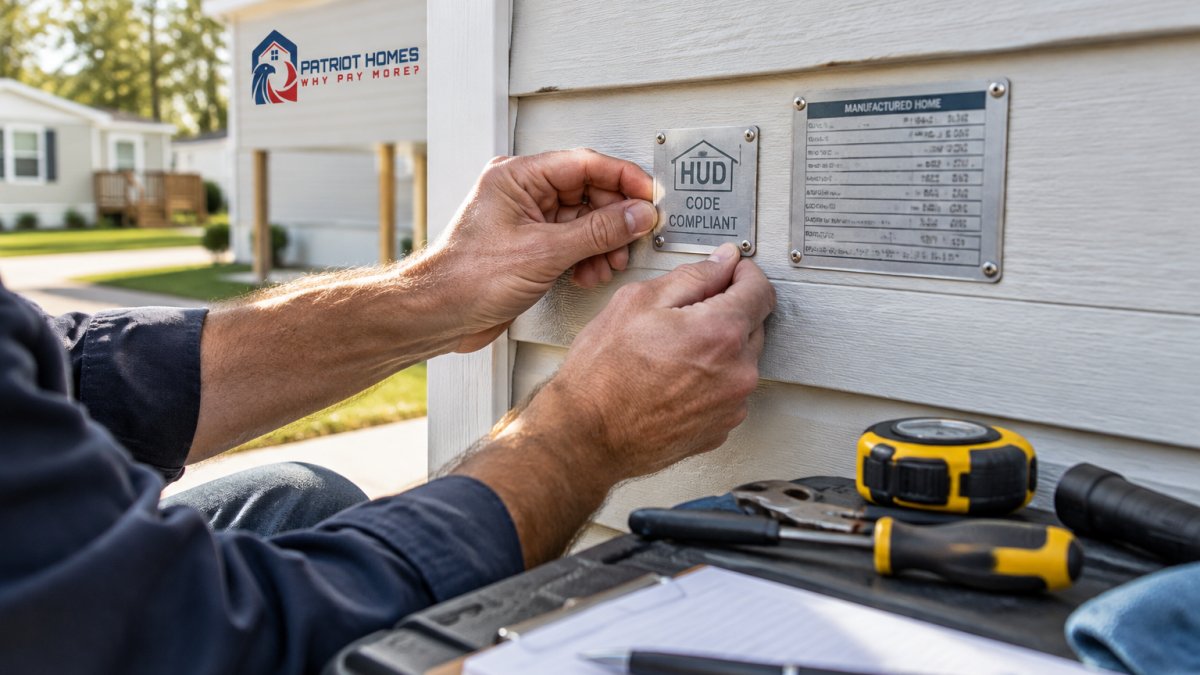
Locating the HUD Certification Label
The certification label is a small metal tag, roughly the size of a credit card, permanently affixed to the exterior of the home.
Where to look, in order:
- Near the electrical panel or the main service entrance
- On the exterior wall at the towing hitch end of each section
- Low on the siding, often within a few feet of the ground
- On the frame or the marriage wall on some older models
The label is usually red or silver and carries a serial number and a certification statement. It is designed to be tamper-evident, so a missing, painted-over, or loose label is a red flag, not a cosmetic issue.
Reading the Data Plate
The data plate is a paper document, usually glued inside a cabinet door, a closet, or the utility area near the furnace or water heater.
Watch out: a missing data plate is a real problem. Without it, some lenders and insurers will decline the home outright, and replacing it means contacting the manufacturer or HUD for records that may no longer exist.
What Verification Means for Financing and Insurance
Verification matters for financing. Appraisers and lenders may review the certification label and data plate when evaluating a home.
Insurance works the same way. Insurers may ask for the certification label before writing a policy. If you are weighing monthly costs against a traditional build, it helps to see how manufactured home payments compare to site-built before you start shopping. The short version: compliance is the difference between a home you can borrow against and one you cannot.
Modifications That Can Void Compliance
Once a home is certified, certain changes can compromise its HUD compliance. Common trouble spots include:
- Removing or covering the certification label or data plate
- Altering the roof structure or adding loads the home was not designed for
- Cutting new openings in exterior walls without engineering review
- Changing the foundation or tie-down system in a way that affects wind resistance
Cosmetic updates such as flooring, cabinets, and paint are generally simpler than structural changes, which need a professional review. If you are unsure whether a planned change affects compliance, call our 24/7 team at (888) 765-1776 and we will walk you through it.
If you are comparing listings, it helps to know how to compare manufactured home prices so you can weigh a compliant home against a cheaper one that may not be.
Manufactured Home vs Site Built Cost Comparison
Costs for manufactured and site-built homes depend on many factors, including land, site work, and utilities.
Where the savings show up:
- Financing terms: manufactured home loans can differ from conventional mortgages
For a full line-by-line breakdown, see our manufactured home vs site built cost comparison. The honest caveat: land costs, utility hookups, and site improvements can swing the total significantly, so the sticker price is never the whole story.
Customizable Manufactured Home Floor Plans
Buyers can choose from a range of floor plans, from one-bedroom to four-bedroom models, with options for finishes and layout.
At Patriot Homes, we carry floor plans across that full range, and we walk buyers through the options so the finished home matches how they actually live. Browse customizable manufactured home floor plans to see what’s available, or call (888) 765-1776 for a pricing matrix.
HUD Code vs Modular Homes: What’s the Difference
HUD Code homes and modular homes are both built in factories, but they are regulated differently, and that difference drives everything downstream, financing, inspection, foundation, and resale.
Manufactured homes follow the federal HUD Code. Modular homes follow the state or local building code where they are installed, the same code a site-built home follows. That single distinction explains most of the confusion beginners run into.
| Feature | HUD Code Manufactured | Modular |
|---|---|---|
| Governing standard | Federal HUD Code | State and local building codes |
| Inspection | Factory, by HUD-approved agencies | Local code officials, often at site |
| Certification | Metal label plus data plate | Local permits and inspections |
| Foundation | Often simpler systems | Typically permanent foundation |
| Financing | FHA and specialized lenders | Conventional mortgage eligible |
| Code updates | Federal, uniform nationwide | Varies by state and municipality |
Why the Distinction Matters for Financing
The financing difference is the one buyers feel first. A HUD Code home can qualify for FHA-backed manufactured home loans, but the lender will require the certification label and data plate, and the appraisal will confirm the home meets the federal standard.
That does not make one better than the other. It means the loan you can get depends on which code the home was built to, so decide your financing path before you fall in love with a floor plan.
How State Codes Interact with the Federal Standard
This is the part most guides skip. The HUD Code is a federal floor, not a ceiling. States and local jurisdictions can add requirements on top of it, installation standards, foundation and tie-down rules, and site-specific wind or seismic provisions, but they cannot weaken the federal standard for a manufactured home.
Modular homes work the other way: the state or local code is the governing standard, and there is no federal overlay. That is why a modular home built for one jurisdiction may need review before it can be installed in another.
Inspection Timing and What It Means for You
HUD Code compliance is verified at the factory, before the home ships, by HUD-approved inspection agencies. Modular compliance is verified by local code officials, often at the site during and after installation.
For a deeper cost comparison between modular and site-built construction, read our modular vs site-built cost comparison. Which one is right for you depends on your land, your lender, and how permanent the installation will be.
Get Your HUD Code Questions Answered by Patriot Homes
We proudly serve local homeowners across California and the surrounding service areas, with custom manufactured and modular options built to fit both your land and your budget.
A few things we can help with right now:
- Confirming whether a home you’re considering meets HUD Code standards
- Walking through floor plans from one-bedroom designs to four-bedroom models
- Explaining customization options and what they mean for your final price
- Answering financing questions so you know what to expect before you apply
Call (888) 765-1776 any time, or request a quote from our website. Call (888) 765-1776 or request a quote from our website for current pricing.
The HUD Code doesn’t have to be intimidating, and you shouldn’t have to decode it alone.
Frequently Asked Questions
What exactly is the HUD Code for manufactured homes?
The HUD Code is the federal construction and safety standard for manufactured homes, set by the U.S. Department of Housing and Urban Development. It covers design, construction, structural integrity, fire resistance, plumbing, electrical systems, and energy efficiency. Every home built to this standard carries a certification label and data plate.
Is the HUD Code the same as local building codes?
No. The HUD Code is a federal performance-based standard that applies to the home itself, while local building codes govern site-built construction and on-site work like foundations and utility connections. A HUD Code home is built in a factory to federal standards, then installed according to local requirements. This split is why installation standards and foundation requirements matter as much as the home’s construction. Ask your dealer how they handle local permits and site work.
How can I verify if a home meets HUD Code standards?
Look for the certification label, a small metal tag usually attached to the exterior near the front door or on the hitch. It confirms the home was built to the HUD Code. Inside, check the data plate, which lists the home’s serial number, wind zone, roof load, and thermal zone. You can also request the home’s documentation from the dealer. Patriot Homes can walk you through these details before you buy, so call (888) 765-1776 with any questions.
Why is the HUD Code important for manufactured home financing?
Lenders and insurers use the HUD Code as a baseline for safety and quality. Lenders and insurers may ask for the certification label when reviewing a home. If you are budgeting, ask about monthly payments and loan options early. Patriot Homes offers pricing matrices and can connect you with financing guidance at (888) 765-1776.
How does the HUD Code ensure home safety and quality?
The code sets performance-based standards for structural integrity, fire resistance, thermal protection, plumbing systems, and electrical safety. Manufacturers operate under the federal standard, and details are available from HUD. The standard also assigns wind zones, roof loads, and thermal zones based on where the home will be installed, so a home in a high-wind area is built to handle those conditions. This is why the data plate matters: it tells you exactly which standards your home was built to meet.
Can I modify a HUD Code home after I buy it?
Yes, but modifications need care. Structural changes, additions, and some electrical or plumbing work may require permits and must not compromise the home’s compliance with the HUD Code. Simple cosmetic updates like paint, flooring, and fixtures are usually straightforward. For anything structural, check with your local building department and a qualified contractor first. Patriot Homes can discuss available customization options with you. Call (888) 765-1776 to discuss options.
