
What Are the Best Manufactured Home Exterior Siding Options?
Last Updated: October 30, 2026
Quick Summary
The best manufactured home exterior siding options are vinyl, fiber cement, engineered wood, aluminum, and steel, and no single material wins everywhere. Choose based on how each handles sun, moisture, wind, and your maintenance tolerance, plus how it fits your home’s wall construction and age.
- Vinyl is the most common manufactured home siding choice because it is affordable and needs almost no upkeep beyond a hose-down.
- Fiber cement is durable and fire-resistant, with one comparison giving a price range of $18 to $22 per square foot for the material.
- A magnet sticks to steel siding and not to aluminum, which helps you identify what is on your home now.
- Siding itself is not insulation, so ask for a quote that separates siding from air-sealing and insulation upgrades.
- Do not let a contractor skip the substrate inspection, since covering failing sheathing or housewrap traps moisture.
Table of Contents
- Mobile Home Siding Types: A Side-by-Side Comparison
- Vinyl Siding: The Most Common Manufactured Home Siding Choice
- Fiber Cement and Engineered Wood Siding for Manufactured Homes
- How to Identify Aluminum or Steel Siding on Your Home
- Manufactured Home Siding Replacement: What the Process Involves
- Matching Siding to Your Climate, Energy Needs, and Budget
- Get Your Siding Questions Answered by Calling (888) 765-1776
- Frequently Asked Questions
Mobile Home Siding Types: A Side-by-Side Comparison
Picking siding for a manufactured home comes down to five real contenders: vinyl, fiber cement, engineered wood, aluminum, and steel. At Patriot Homes, we walk buyers through manufactured home exterior siding options every week, and the honest answer is that no single material wins everywhere. What matters is how each one handles sun, moisture, wind, and your maintenance tolerance, and, just as important, how it fits the wall construction and age of your specific home.
The broader market backs up the interest. According to National Association of Home Builders’ Eye on Housing analysis, 27.7% of single-family homes started in 2025 used vinyl as the principal exterior wall material, with stucco at 24.1%. That is single-family data, not manufactured-home data, but it tells you vinyl is the default choice across American housing for a reason.
Here is the short version before we dig in:
| Material | Typical Lifespan Range | Upkeep | Impact Resistance | Insulation Options | Repairability | Best For |
|---|---|---|---|---|---|---|
| Vinyl | 10-20 years (conservative) to 20+ years (optimistic) | Low, hose-down | Low to moderate; thin panels crack in extreme heat or cold | Insulated vinyl with foam backing available | Patch or replace individual panels | Budget-first buyers, broad color and profile choice |
| Fiber cement | Around 50 years per one estimate | Moderate, periodic repaint | High; resists hail and debris | Can be installed over rigid foam | Sectional repair is possible but color-match is hard | Fire resistance, longevity, permanent-foundation homes |
| Engineered wood | Varies by product; shorter than fiber cement in most guides | Moderate, repaint on schedule | Moderate | Limited factory options | Replace damaged boards | Wood look at lower cost than solid wood |
| Wood | Up to 40 years per one guide | High, paint, caulk, pest watch | Moderate | None built in | Replace individual boards | Natural appearance, heritage homes |
| Aluminum | Long service life when coating holds; dents shorten it | Low | Low, dents easily | None built in | Difficult; dents are permanent | Older homes, retrofits, insect resistance |
| Steel | Long service life when coating holds | Low | High, resists impact | None built in | Difficult; rust is the failure mode | Impact and pest resistance |
How the Materials Stack Up on Durability and Upkeep
Published lifespan figures for siding swing wildly, and that is the first thing to understand. One guide puts vinyl at 20+ years, wood up to 40 years, and fiber cement around 50 years, while another says vinyl generally needs replacement every 10 to 20 years, per Plum Pro Exteriors’ mobile home siding guide.
So treat every lifespan number as a range, not a promise. Installation quality, sun exposure, and how well you keep up with cleaning move the needle more than the brochure does.
Manufactured-Home Compatibility: What Actually Drives the Choice
This is where most siding guides go quiet, and it matters more than the material brochure. Four factors on a factory-built home change which siding makes sense:
- Home age and wall construction. Older manufactured homes often used thinner wall assemblies and different fastening patterns than current HUD-code homes. Heavier materials like fiber cement need fasteners and sheathing that can carry the load; on some older walls, that means adding sheathing or furring first.
- Existing siding and trim. Layering new siding over failing substrate traps moisture. A qualified installer will check for soft sheathing, failed housewrap, and trim rot before quoting a replacement.
- Factory-built details. Window and door flanges, corner trim, and the marriage line on multi-section homes are common leak points. Siding choice should account for how those transitions get flashed and finished.
If you are unsure what your home can carry, call (888) 765-1776 and our 24/7 team can help you get started before you commit to a material.
Before you compare materials, take three photos: a close-up of the existing siding profile, the corner trim, and the area under a window. Any installer or our team can use those to flag compatibility issues fast.
A Note on Matching the Look to the Neighborhood
Appearance is not just vanity, it affects resale and HOA or park approval in many communities. If you are weighing finishes against a budget, our guide to custom home finishes on a budget walks through the trade-offs, and our team can also talk through floor plans from 1-bedroom ADUs to spacious 4-bedroom models so the exterior and interior choices line up.
Vinyl Siding: The Most Common Manufactured Home Siding Choice
Vinyl is the most common manufactured home siding choice, and for good reason: it is affordable, available in dozens of profiles, and needs almost no upkeep beyond a hose-down.
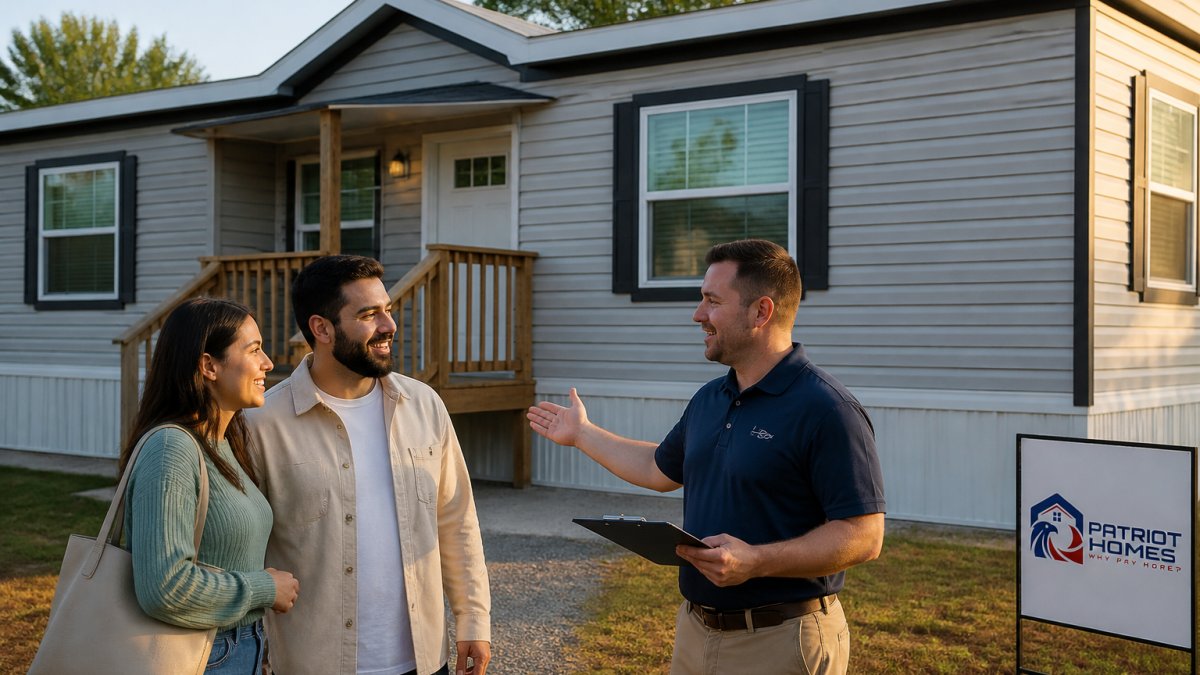
Modern vinyl comes in lap, board-and-batten, and shake profiles. Allura’s siding style guide lists traditional lap with wood-grain texture, vertical-groove board-and-batten, straight-edge shake, and octagon shake designs, so you are not stuck with one flat look.
Fiber Cement and Engineered Wood Siding for Manufactured Homes
Fiber cement and engineered wood are the upgrade picks. Fiber cement is durable and fire-resistant, and one comparison gives a price range of $18 to $22 per square foot for the material, according to Braustin’s mobile home siding comparison.
The trade-off is weight and installation complexity. Fiber cement is heavy, so it needs proper fastening and a contractor who knows manufactured home walls.
How to Identify Aluminum or Steel Siding on Your Home
Not sure what is on your home now? Aluminum and steel siding look similar from the curb but behave differently. Aluminum dents; steel resists impact but can rust if the coating fails.
Here is how to tell them apart:
- Magnet test: A magnet sticks to steel and not to aluminum.
- Tap test: Aluminum sounds dull and hollow; steel rings sharper.
- Dent check: Look for soft dents near doors and corners; those point to aluminum.
Neither is a match for every climate, so confirm before you plan a replacement.
Manufactured Home Siding Replacement: What the Process Involves
Replacement follows a predictable path: assess the existing panels and trim, check for moisture damage underneath, remove old siding, inspect and repair the sheathing, then install new panels with proper flashing around windows, doors, vents, and the gutter line.
If your home sits on a permanent foundation, the project may overlap with structural work. Our guide to manufactured home foundation types explains what to expect there.
Budget assumptions matter more than the sticker price. Ask for a line-item quote, not a lump sum.
Matching Siding to Your Climate, Energy Needs, and Budget
Climate decides more than style, and on a manufactured home it also decides how the siding interacts with the wall assembly. Here is how to think about it in practical terms.
Climate-by-Climate Starting Points
- Hot, sunny, inland areas. Lighter colors are generally a sensible choice in strong sun, and the right siding choice depends on your specific home and location. For a closer look at how siding and efficiency come together in a hot climate, see energy efficient manufactured homes in Arizona.
- Wet and coastal areas. Moisture and rot resistance move to the top of the list. Proper flashing, housewrap, and clearance above grade are the key defenses against moisture.
- Windy and hail-prone zones. Impact resistance matters, so consider how each material performs in your wind and weather conditions.
Energy Efficiency: What Siding Can and Cannot Do
Siding itself is not insulation. On a manufactured home, energy gains often come from sealing penetrations and addressing window and door air leaks, and siding replacement can be a good time to do that work.
If energy performance is a priority, ask for a quote that separates siding from air-sealing and insulation upgrades so you can see what each layer contributes.
Total Installed Cost: What the Sticker Price Leaves Out
Material cost per square foot is only part of the total installed cost. A realistic quote for a manufactured home siding replacement typically accounts for:
- Materials and labor, panels, trim, accessories, removal, and installation.
- Repairs uncovered during removal, soft sheathing, failed flashing, or trim rot that was hidden.
- Permits and inspection, requirements vary by jurisdiction and by whether the home sits on a permanent foundation.
Ask for a line-item quote, not a lump sum, so you can compare bids on the same scope. For a pricing matrix tailored to your home and area, call (888) 765-1776, our 24/7 team can walk you through what drives the number up or down.
Permits, Codes, and Warranties
Manufactured homes fall under HUD code for construction, but siding replacement on site can trigger local permitting, especially on permanent foundations. Manufacturer warranties on siding products can carry installation and coverage conditions, so read the warranty before you sign and confirm who handles a claim if a panel fails.
Do not let a contractor skip the substrate inspection. Covering failing sheathing or housewrap traps moisture and shortens the life of even premium siding.
Repair vs. Replace: The Lifecycle Trade-Off
Patching is viable when damage is isolated, a cracked vinyl panel, a dented aluminum section, a single rotted engineered-wood board. Replacement makes more sense when failures are widespread, when the existing material is at the end of its service life, or when repairs keep recurring at seams and penetrations.
Best for: Vinyl if budget leads; fiber cement if longevity and fire resistance lead; engineered wood if you want the wood look for less.
Get Your Siding Questions Answered by Calling (888) 765-1776
Siding is one of the fastest ways to change how a manufactured home looks and performs, and you do not have to guess at it alone.
Call (888) 765-1776 for a pricing matrix, customization options, or immediate assistance. You can also request a quote from our website, and explore manufactured home customization on a budget to compare floor plans, upgrades, and finishes before you call.
Frequently Asked Questions
What kind of siding is used on mobile homes?
Vinyl is the most common choice, and it is one of five material categories named in manufactured-home siding guides, alongside fiber cement, metal, wood, and engineered wood. Vinyl is the most widely used siding across American housing generally, though that figure covers single-family homes rather than manufactured homes specifically. Your dealer can confirm which materials are available on the floor plans you are considering. Call (888) 765-1776 to ask about current siding choices.
How can I tell if my siding is aluminum or steel?
A magnet is the fastest test. Steel siding attracts a magnet; aluminum does not. You can also press a panel with your thumb: aluminum dents more easily and feels softer, while steel resists denting but can rust at scratches and cut edges. Look at exposed edges and seams for rust-colored staining, which points to steel, or for white chalky oxidation, which points to aluminum. If you are unsure, ask a siding contractor to confirm before you plan a repair or replacement.
Can you replace the siding on a manufactured home?
Yes. Manufactured home siding replacement is a routine project, and older metal or wood panels are commonly swapped for vinyl or fiber cement. The work involves removing the old panels, inspecting the sheathing and moisture barrier underneath, then installing new panels with trim, vents, and accessories. Because manufactured homes have specific wall assemblies, the installer should confirm compatibility with your home’s construction before ordering material. Patriot Homes serves homeowners across the region and can walk you through options at (888) 765-1776.
Which siding is best for a manufactured home?
There is no single best answer. Vinyl is generally low-maintenance, fiber cement is known for durability, and wood can last a long time with proper care. Climate, budget, and how much upkeep you want all shape the decision. Ask for a quote from our team at (888) 765-1776 to match a material to your home and location.
The right siding choice protects your home, cuts maintenance, and lifts curb appeal, but the decision gets easier with real numbers in front of you. Patriot Homes offers customizable manufactured homes, lowest possible pricing, and 24/7 customer support to guide you through every step. Get started with Patriot Homes and choose the exterior that fits your climate and your budget.
